ℹ️ Disclaimer: This article is for general educational and informational purposes only. All expense ratio figures, fund examples, return projections, and cost calculations are illustrative only and do not represent actual current data or guarantee future performance. Mutual fund investments are subject to market risk. Please read all scheme-related documents carefully and consult a SEBI-registered investment advisor before investing. RozHisab is a personal finance tracking tool — not an investment advisory service.
Here is a fee you pay every single day you hold a mutual fund in India.
It is deducted automatically — before the NAV is calculated, before the returns are reported, before any number you ever see is published. You never receive a deduction notice. You never see a line item. You never sign anything authorising the deduction.
It simply happens, every market day, invisibly, for as long as you hold the fund.
This fee is called the expense ratio.
For most Indian mutual fund investors, this is the most significant financial cost they are paying — and the one they understand least.
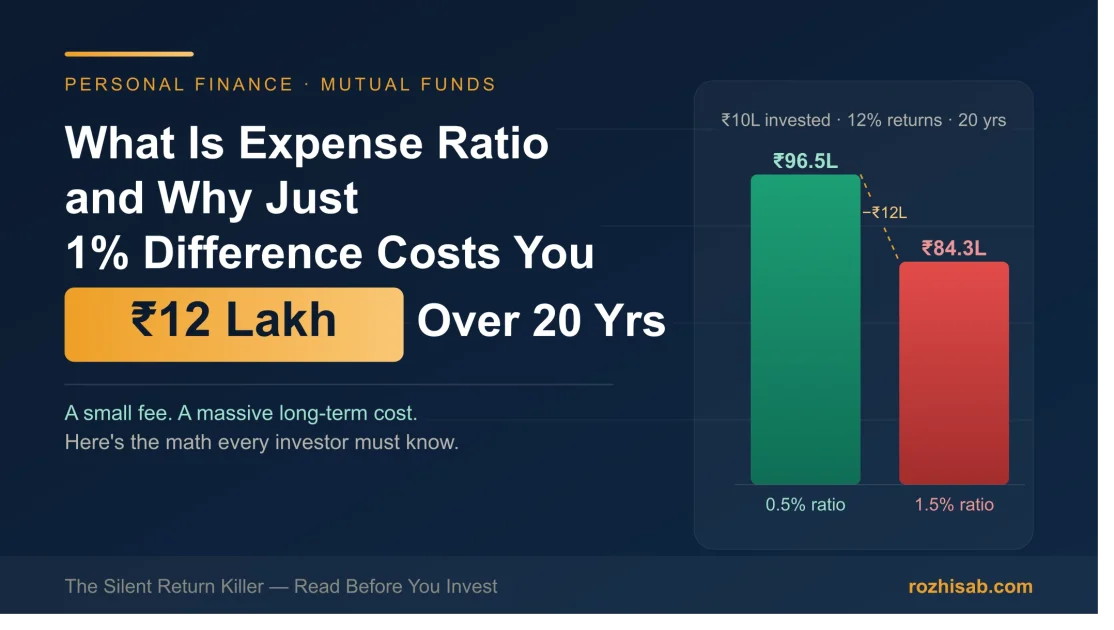
On a ₹5,000/month SIP over 20 years, the difference between a fund with a 0.10% expense ratio and one with a 1.10% expense ratio is approximately ₹12 lakh in final corpus.
Same fund category. Same market returns. Same investor. Same SIP amount. ₹12 lakh difference — entirely created by a 1% fee gap you never noticed because you never received a bill for it.
This article explains what expense ratio is, how it silently compounds against you, what exit load is and how it works, why direct plans give you more money than regular plans, and exactly which funds have the lowest expense ratios in India right now.
What Is Total Expense Ratio in Mutual Funds
What Is Expense Ratio
Expense ratio (also called Total Expense Ratio or TER) is the annual fee charged by a mutual fund to cover all costs of running the fund — expressed as a percentage of the fund's total assets under management (AUM).
What is total expense ratio: Total Expense Ratio is the complete annual cost of owning a mutual fund, expressed as a percentage. It covers:
- Fund management fee: Paid to the fund manager and their investment research team. The largest component of TER.
- Administrative expenses: Record keeping, account statements, customer service, compliance costs.
- Distribution and marketing: Costs of promoting the fund and paying distributors/agents. This is where Regular Plan and Direct Plan diverge significantly.
- Registrar and transfer agent fees: Paid to CAMS or KFintech for maintaining investor records.
- Trustee fees: Paid to the board of trustees who oversee the fund house.
How expense ratio works in practice: If a fund has a TER of 1.5% per year, the fund deducts 1.5% ÷ 365 = 0.00411% of the fund's total assets every day. This deduction happens before the NAV is published — so the NAV you see already has the fee taken out. You never see the deduction. You only see the net NAV.
What is base total expense ratio in mutual fund: Base TER is the expense ratio before adding GST on management fees. The final expense ratio you pay includes 18% GST on the management fee component — making the actual cost slightly higher than the base TER quoted in fund documents. SEBI mandates disclosure of the total (post-GST) expense ratio, which is the number you should compare across funds.
How to Calculate Expense Ratio in Mutual Fund
Expense ratio formula:
Expense Ratio = Total Annual Expenses
÷ Average AUM × 100
Example:
Fund's total annual expenses: ₹15 crore
Fund's average AUM: ₹1,000 crore
Expense Ratio = ₹15 crore ÷ ₹1,000 crore × 100
= 1.5%
You don't need to calculate this yourself. Every mutual fund's current expense ratio is disclosed on:
- The fund house's official website (under fund factsheet)
- AMFI website (amfiindia.com → NAV/Data → TER)
- Value Research Online and Morningstar India
The ₹12 Lakh Calculation — Exactly How Expense Ratio Destroys Your Returns
This is the number that should make every mutual fund investor check their expense ratios immediately.
Scenario: ₹5,000/month SIP
for 20 years
Assumed gross market return: 12% per year
(the approximate long-term average
of the Nifty 50 — not a guarantee)
Fund A — 0.10% expense ratio
(Direct Index Fund):
Net return after expense: 11.90%/year
Final corpus after 20 years:
approximately ₹4,33,000 wait —
let's be precise:
Illustrative SIP corpus comparison (₹5,000/month, 20 years):
- At 12.00% (zero expenses): approximately ₹49.9 lakh
- At 11.90% (0.10% TER — direct index): approximately ₹48.9 lakh
- At 11.00% (1.00% TER — direct active): approximately ₹43.7 lakh
- At 10.50% (1.50% TER — regular plan): approximately ₹41.1 lakh
- At 10.00% (2.00% TER — regular high): approximately ₹38.8 lakh
The gap between 0.10% TER and 1.10% TER: ₹48.9 lakh − ₹43.7 lakh = ₹5.2 lakh on ₹5,000/month SIP
The gap between 0.10% TER and 2.00% TER: ₹48.9 lakh − ₹38.8 lakh = ₹10.1 lakh on ₹5,000/month SIP
Scale to ₹10,000/month SIP: the gap doubles to ₹20 lakh.
⚠️ These figures are illustrative projections assuming constant 12% gross market return — not guaranteed outcomes. Actual returns vary based on market conditions.
Why the gap is so large: The expense ratio is not deducted from your returns once — it is deducted every day, compounding against you over 20 years. The fee itself compounds. Every rupee taken as expense ratio is a rupee that cannot compound for the remaining years of your investment horizon.
This is why the gap between 0.10% and 2.00% expense ratio is not simply (2.00% − 0.10%) × 20 years = 38% of your investment. It is far more — because of the compounding effect on every rupee of fee deducted every single day for 20 years.
SEBI Expense Ratio Limits — What the Regulator Says
SEBI (Securities and Exchange Board of India) caps the maximum expense ratio a mutual fund can charge. The limits decrease as the fund's AUM increases (larger funds must charge less):
Equity funds TER limits (SEBI):
- First ₹500 crore AUM: maximum 2.25%
- Next ₹250 crore: maximum 2.00%
- Next ₹1,250 crore: maximum 1.75%
- Next ₹3,000 crore: maximum 1.60%
- Next ₹5,000 crore: maximum 1.50%
- Next ₹40,000 crore: sliding scale to 1.05%
- Above ₹50,000 crore: maximum 0.80%
Debt funds TER limits: Approximately 0.25% lower than equity fund limits at each AUM tier.
Index funds and ETFs: Maximum 1.00% — and in practice, well-run index funds charge 0.10–0.20%.
These are the SEBI maximums. The actual expense ratio charged by specific funds can be — and should be — significantly below these maximums. Comparing a fund's actual TER to both the SEBI maximum and to category peers is how you evaluate whether you're paying fairly.
Lowest Expense Ratio Mutual Funds in India — What to Look For
Lowest expense ratio mutual funds are almost always in two categories:
1. Index Funds (Direct Plans): The lowest expense ratios in India are in Nifty 50 and Nifty Next 50 index funds. These funds passively track an index — no active stock picking, no expensive research team. All they need to do is replicate the index composition.
As of 2026, the lowest expense ratio Nifty 50 index funds include:
- Nippon India Index Fund Nifty 50: approximately 0.10%
- UTI Nifty 50 Index Fund: approximately 0.18%
- HDFC Nifty 50 Index Fund: approximately 0.20%
- Motilal Oswal Nifty 50 Index Fund: approximately 0.10%
⚠️ These figures change frequently as fund houses adjust their TERs. Always verify current TER on the fund house's website or AMFI before investing.
2. Large AUM Active Funds (Direct Plans): Very large funds (AUM above ₹50,000 crore) are required by SEBI to charge lower expense ratios. Some of India's largest equity funds have TERs in the 0.60–0.90% range for Direct Plans.
The practical rule: For index funds and ETFs — choose the one with the lowest TER among options tracking the same index. Performance will be nearly identical; the lower TER fund will mechanically deliver marginally better net returns.
For active funds — a higher TER is justified only if the fund consistently outperforms its benchmark by more than the TER difference. A fund charging 1.5% TER that outperforms its benchmark by 3% is delivering more value than a fund charging 0.5% that only matches its benchmark.
Direct Plan vs Regular Plan — The Expense Ratio Connection
What Is Regular Plan in Mutual Fund
What is regular plan in mutual fund: A regular plan is a version of a mutual fund scheme where you invest through a distributor, agent, or broker — such as a bank, insurance agent, or financial advisor who receives a commission from the fund house for bringing in your investment.
This commission — called trail commission or distribution expense — is included in the regular plan's expense ratio. The distributor typically earns 0.50–1.00% per year on your invested amount, paid by the fund house from the expense ratio they charge you.
What Is Direct Plan in Mutual Fund
What is direct plan in mutual fund: A direct plan is the exact same fund without the distributor commission. You invest directly with the fund house (via their website, app, or platforms like Zerodha Coin, Groww, Paytm Money) without any intermediary.
Because there is no distributor to pay, the direct plan's expense ratio is 0.50–1.50% lower than the regular plan of the same fund. Same fund manager. Same portfolio. Same stocks. Lower fee.
What Is Regular and Direct Plan in Mutual Fund — Side by Side
Illustrative comparison of same fund in two plans:
- Fund name: Mirae Asset Large Cap Fund
- Regular Plan TER: approximately 1.56%
- Direct Plan TER: approximately 0.54%
- TER difference: 1.02% per year
On ₹10 lakh invested for 15 years at 12% gross market return (illustrative, not guaranteed):
- Regular Plan (11.44% net return): approximately ₹46.8 lakh
- Direct Plan (12.46% net return): approximately ₹53.2 lakh
- Difference: ₹6.4 lakh over 15 years on ₹10 lakh
The regular vs direct plan choice is the single most impactful fee decision any Indian mutual fund investor makes. It is also the simplest — always choose Direct Plan when investing for yourself without needing ongoing personalised advice.
When regular plan might be justified: If you engage a SEBI-registered investment advisor (RIA) who charges a flat fee for advice and uses direct plans — you get professional guidance without the commission structure. If you invest through a bank or agent who recommends funds in exchange for trail commission — you are in a regular plan and paying 0.50–1.50% extra annually for that recommendation. Whether the recommendation is worth that ongoing cost is a decision worth evaluating honestly.
Mutual Fund Expense Ratio Calculator — How to Estimate the Cost Impact
Mutual fund expense ratio calculator — simple manual method:
To estimate the rupee cost of a specific TER on your investment:
Annual cost estimate:
Annual Fee = Investment Amount
× Expense Ratio
₹5 lakh × 1.5% = ₹7,500/year
₹5 lakh × 0.10% = ₹500/year
Difference per year: ₹7,000
This ₹7,000 annual difference doesn't just cost you ₹7,000. It costs you ₹7,000 that cannot compound for the remaining years of your investment — making the actual cost significantly higher than the annual figure suggests.
For SIP investments: Your investment grows month by month. The base amount on which TER applies grows every year. So the rupee cost of the same percentage TER increases every year as your corpus grows.
Free online expense ratio calculators are available at: Groww.in/tools/mutual-fund-calculator, ET Money, and Zerodha Coin — all have TER comparison tools that show you the direct impact of expense ratio on your specific investment amount and time horizon.
What Is Exit Load in Mutual Fund — The Other Hidden Cost
Exit Load Meaning
Exit load meaning: Exit load is a fee charged by a mutual fund when you redeem (sell) your units before a specified holding period. It is expressed as a percentage of the redemption amount.
What is exit load: Exit load is designed to discourage short-term trading in mutual funds — discouraging investors from treating mutual funds like a savings account and withdrawing whenever they want. It protects long-term investors in the fund from the costs that frequent redemptions impose on the fund.
Exit Load in Mutual Fund — Standard Rates
Typical exit load in mutual fund by category (verify current rates on fund documents before investing):
- Equity funds: Most charge 1% exit load if redeemed within 1 year of investment. No exit load after 1 year.
- ELSS funds: No exit load — but has a mandatory 3-year lock-in. You cannot exit early even if you wanted to pay a load.
- Liquid funds: Exit load applies for first 7 days only (graded exit load: Day 1: 0.0070%, Day 2: 0.0065%, declining to Day 7: 0.0010%, Day 8+: Nil)
- Debt funds: Many have no exit load at all. Some short-duration funds charge 0.25–0.50% if redeemed within 30–90 days.
- Index funds: Many index funds charge no exit load. Some charge 0.25% within 7–30 days. Always check the specific fund.
How Exit Load Is Calculated
How to calculate exit load:
Exit Load Amount =
Redemption Value × Exit Load Rate
Exit load calculator — example:
You invested ₹1,00,000 in an equity fund
with 1% exit load if redeemed within 1 year.
After 8 months, fund value: ₹1,15,000.
You redeem all units.
Exit load = ₹1,15,000 × 1% = ₹1,150
Amount you receive = ₹1,15,000 − ₹1,150
= ₹1,13,850
How exit load is calculated for SIP: Each SIP instalment has its own exit load period — independently. If you started a SIP in January 2025 and redeem all units in September 2025 (8 months after start):
- January SIP units → 8 months old → still within 1-year exit load period → exit load applies
- All units purchased within last 12 months → exit load applies to all
- Only units older than 12 months are exit load free
This is the FIFO principle for exit load — oldest units are redeemed first, which means in a continuing SIP, partial redemption after 12+ months may be exit-load-free for older units but not for recent ones.
Exit Load vs Expense Ratio — The Key Difference
Exit load is a one-time fee paid only when you redeem — and only if you redeem before the exit load period. It disappears after you hold long enough.
Expense ratio is a continuous, daily deduction that never stops as long as you hold the fund. Even after 20 years of holding, the expense ratio continues to be deducted every day.
For long-term investors, the expense ratio has a far greater total impact than the exit load. For short-term investors who plan to exit within 1 year — exit load is the more immediately painful fee.
The Average Return on SIP — What Expense Ratio Does to It
What is the average return on SIP in India: For Nifty 50-based index fund SIPs, the 10-year SIP returns (as of 2026) have ranged from approximately 11–14% XIRR depending on entry period, market conditions, and the specific fund. The 20-year figure has historically been in the 12–15% XIRR range for Indian large-cap equity SIPs.
These are historical figures — not guaranteed future returns.
What expense ratio does to your SIP returns in practice:
- 0.10% TER fund: almost all of the 12–14% market return flows to you
- 1.50% TER fund: your net return is 10.5–12.5% — the fund and its distributor kept 1.50%/year of what the market delivered
Over 20 years of SIP, that 1.50% retention compounds silently into the ₹10–₹15 lakh gap discussed at the start of this article.
How to calculate SIP returns in Excel:
Use the XIRR function in Excel
(or Google Sheets) — not CAGR,
which assumes a single lump sum.
In Excel/Sheets:
Column A: Dates of each SIP instalment
(negative amounts — money going out)
+ redemption date (positive amount — money coming in)
Column B: Corresponding amounts
(negative for payments, positive for receipt)
Formula: =XIRR(B1:Bn, A1:An)
This gives you your exact annualised return accounting for all SIP dates — which is always different from the fund's quoted CAGR.
The Practical Checklist — What to Do With This Information Today
Step 1 — Check your current fund's TER: Go to your fund house's website or valueresearchonline.com → search your fund → Basics tab → look for "Expense Ratio." Is it above 1%? You may be in a regular plan or a high-cost active fund.
Step 2 — Check if you're in Regular Plan or Direct Plan: Your fund statement or your Zerodha/Groww portfolio shows this. If it says "Regular" next to the fund name — you are paying commission. Calculate what the TER difference is between the regular and direct version of your fund on amfiindia.com → compare this with the value you're getting from your distributor.
Step 3 — For index funds, always choose lowest TER: If two Nifty 50 index funds from different fund houses track the same index, the one with lower TER will mechanically deliver better net returns. This is the only decision where lower cost is a complete proxy for better outcome.
Step 4 — For active funds, evaluate TER against outperformance: Is the fund's 5-year and 10-year return (in Direct Plan) beating its benchmark by more than its TER? If not — an index fund at 0.10% does more for your wealth than the active fund at 1.5%.
Step 5 — Check exit load before redeeming: Before you redeem any mutual fund unit, check the fund's exit load policy on the fund house website. If you are within the exit load period — waiting a few more weeks to cross the 1-year mark saves 1% on your entire redemption value.
Track Your Investment Costs Alongside Your Returns
Most investors track their mutual fund returns. Almost none track the fees they are paying to earn those returns — which means they are evaluating only half the picture.
A fund that delivered 14% gross return while charging 2% TER gave you 12%. A fund that delivered 13% gross return while charging 0.15% TER gave you 12.85%. The second fund performed better for you despite appearing to have lower headline returns — because the cost structure made the difference.
Use RozHisab to track your investment portfolio alongside your monthly income and expenses. Log your SIP contributions, note which funds you're investing in and whether they are direct or regular plans, and see your complete financial picture — what goes in, what comes out, and how your savings rate is trending alongside your investment growth.
Because building wealth through mutual funds requires two things working together: money going in consistently every month AND that money not being quietly eroded by fees you never noticed.
The first is a habit. The second is a one-time informed decision. Both require visibility to get right.
👉 Start tracking your investments and monthly finances for free at RozHisab — log your SIPs, see your expenses, and build the financial clarity that turns good intentions into actual wealth over 20 years.
Quick Reference — Expense Ratio and Exit Load Cheatsheet
- 📊 What is expense ratio: Annual fee deducted daily from fund assets. Expressed as % of AUM. Never billed separately — subtracted before NAV is published.
- 📊 Total expense ratio (TER): Includes management fee + admin + distribution + trustee + GST on management fee.
- 📊 1% TER difference over 20 years: Costs approximately ₹10–₹20 lakh on a ₹5,000–₹10,000/month SIP (illustrative — actual varies with returns).
- 📊 Lowest expense ratio funds: Nifty 50 index funds (Direct Plans) at 0.10–0.20% TER.
- 📊 Direct plan vs Regular plan: Direct = no distributor commission. TER difference: 0.50–1.50% per year. Always choose Direct for self-managed investing.
- 📊 Exit load meaning: One-time fee on redemption if you exit before the exit load period ends.
- 📊 Standard equity fund exit load: 1% if redeemed within 1 year. Zero exit load after 1 year.
- 📊 Exit load vs expense ratio: Exit load: one-time, avoidable by holding. Expense ratio: continuous, daily, unavoidable.
- 📊 Average SIP return in India: Nifty 50 SIP XIRR historically 11–14% over 10–20 year periods. Your net return = market return minus TER.
📌 Disclaimer: This article is for educational and informational purposes only. All expense ratio figures, fund examples, return projections, exit load rates, and cost calculations are illustrative only and subject to change. Actual fund TERs change frequently — verify on amfiindia.com or the fund house website before investing. Mutual fund investments are subject to market risk. Read all scheme documents carefully. Consult a SEBI-registered investment advisor before making investment decisions. RozHisab is a budgeting and expense tracking tool — not an investment advisory service.
Track your own finances — free forever
Use RozHisab to apply everything in this article to your actual spending and savings.
Start Tracking Free →