ℹ️ Disclaimer: This article is for general educational and informational purposes only. F&O taxation, tax audit rules, turnover calculations, and set-off provisions are complex and change with each Union Budget and CBDT notification. All figures and rules here are based on provisions applicable for FY 2025-26 / AY 2026-27 at time of writing and may have changed. Always consult a qualified chartered accountant before filing ITR with F&O income or loss. RozHisab is a personal finance tracking tool — not a tax advisory or CA service.
Here is what most salaried people trading in Futures and Options do not know — and what costs them penalties every year:
F&O trading is not treated as capital gains by the Income Tax Department.
It is treated as business income.
This single classification changes everything: which ITR form you must file, whether tax audit applies to you, how your losses can be used, and what happens if you ignore it.
SEBI data shows that over 1.1 crore Indians traded F&O in FY 2024-25. The same SEBI study found that over 90% of retail F&O traders made a net loss. Most of them did not report that loss in their ITR. Most of them do not know they were legally required to.
This guide explains every F&O tax rule in India — audit requirement, loss reporting, set-off, carry forward, and the exact steps to file correctly.
Why F&O Is Business Income — Not Capital Gains
The first and most important concept to understand before anything else:
When you buy and sell equity shares for delivery — you pay capital gains tax (STCG at 20% or LTCG at 12.5%). This is because you are investing.
When you trade in Futures and Options — the Income Tax Department treats this as speculative or non-speculative business income, not as investment. The reasoning: F&O is a derivative contract that settles in cash or is squared off before delivery. You are not acquiring the underlying asset — you are trading a contract.
The two categories of F&O income:
Futures trading and Options trading —
Non-speculative business income
Both F&O segments are classified as
non-speculative business income under
Section 43(5) of the Income Tax Act.
This is the same category as any
regular business — a shop, a freelancer,
a consultant.
Intraday equity trading —
Speculative business income
Buying and selling equity shares
on the same day (without taking delivery)
is treated as speculative business income —
a separate category with different
loss set-off rules (covered below).
What business income classification means for you:
- You must file ITR-3 (not ITR-1, not ITR-2 — even if you are a salaried employee)
- Your F&O income or loss must be reported under Schedule P&L (Profit and Loss)
- Tax audit rules apply based on your F&O turnover — explained in detail below
- You can claim business expenses against F&O income — brokerage, STT, internet charges, subscriptions, CA fees for filing
What Is Tax Audit in India
What Is Tax Audit
What is tax audit in India: A tax audit under Section 44AB of the Income Tax Act is a mandatory audit of a taxpayer's accounts conducted by a practising Chartered Accountant (CA). The CA examines your financial records, verifies the accuracy of income and deductions reported, and submits a Tax Audit Report (Form 3CA/3CB along with Form 3CD) to the Income Tax Department before you file your ITR.
What is tax audit report: The tax audit report is the formal document submitted by the CA to the Income Tax portal. It contains: your financial statements, reconciliation of income with books, details of deductions claimed, TDS deducted, and specific disclosures required under various income tax provisions.
How to do tax audit: You cannot conduct a tax audit yourself. You must engage a practising CA who holds a Certificate of Practice. The CA audits your books, prepares Form 3CD, and uploads the signed report on the income tax portal before the deadline.
Income tax audit report due date: The tax audit report must be filed by September 30 of the Assessment Year — one month before the ITR deadline for businesses requiring audit (which is October 31 for those with audit). For AY 2026-27: tax audit report by September 30, 2026.
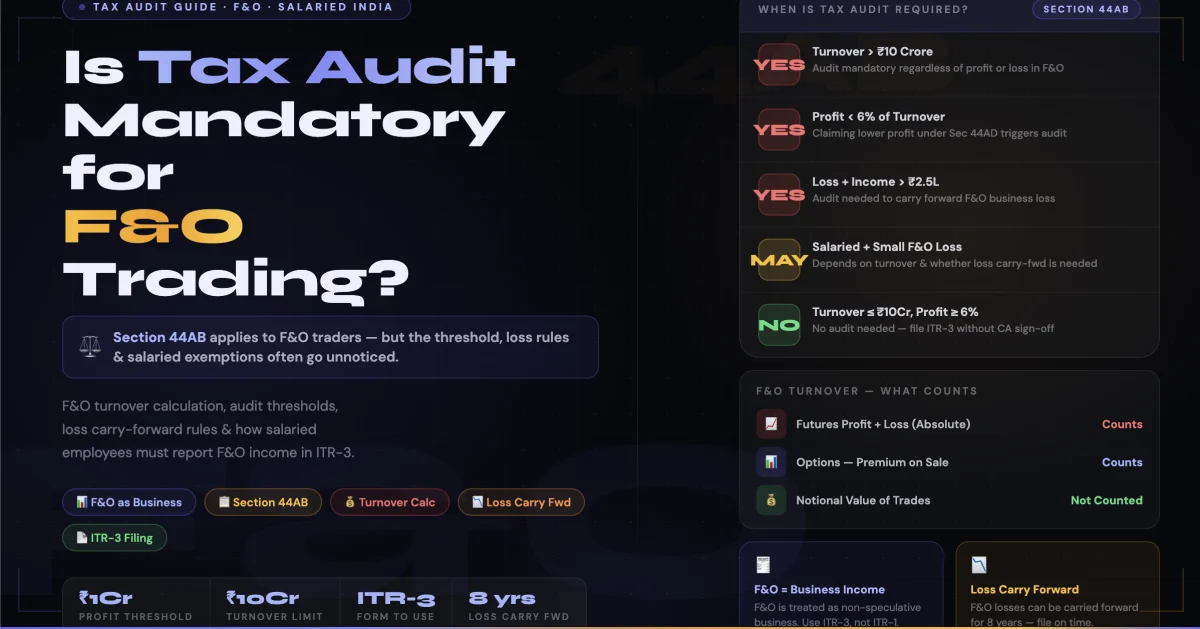
Is Tax Audit Mandatory for F&O Trading?
This is the central question — and the answer depends on your F&O turnover, not your profit or loss.
How F&O Turnover Is Calculated
F&O turnover is calculated differently from regular business turnover. It is not the total value of contracts traded — it is the absolute sum of profits and losses.
F&O turnover formula:
- Futures:
Sum of absolute value of all
profit and loss on each trade
(whether positive or negative).
Example: Trade 1 profit ₹5,000, Trade 2 loss ₹3,000, Trade 3 profit ₹2,000 → Turnover = ₹5,000 + ₹3,000 + ₹2,000 = ₹10,000 - Options:
Sum of absolute value of
profit/loss on each trade
PLUS the premium received on options sold.
This makes options turnover potentially very high even on small absolute gains/losses.
Important: Turnover in F&O context is calculated trade-by-trade, not on net position. Even if your net result for the year is a ₹2 lakh loss, your F&O turnover could be ₹40–₹80 lakh or more depending on how many trades you did.
Tax Audit Threshold for F&O Traders
Is tax audit compulsory for F&O loss? Here is the complete rule:
Case 1 — F&O turnover below ₹1 crore:
Tax audit is NOT mandatory
under Section 44AB — UNLESS
you are reporting a loss or profit
less than 6% of turnover AND
your total income (salary + F&O +
all other sources) exceeds the
basic exemption limit
(₹3 lakh new regime / ₹2.5 lakh old regime).
If turnover is below ₹1 crore AND you're
reporting a profit of 6%+ of turnover
— you can use presumptive taxation
under Section 44AD (no audit needed).
If turnover is below ₹1 crore AND
you're reporting a loss (most F&O traders)
— tax audit IS required
if your total income exceeds the
basic exemption limit.
Case 2 — F&O turnover ₹1 crore to ₹10 crore:
Tax audit is NOT mandatory
if cash transactions are less than 5%
of total receipts and payments
(i.e., 95%+ of transactions are digital).
Since F&O trading is 100% digital,
most traders in this bracket
are exempt from audit under
the enhanced digital transaction limit.
Case 3 — F&O turnover above ₹10 crore:
Tax audit is mandatory
regardless of profit or loss.
Practical summary for most salaried F&O traders (turnover below ₹1 crore):
- Made a profit AND profit ≥ 6% of turnover → No audit needed (use 44AD or declare normally)
- Made a profit but profit < 6% of turnover AND total income > exemption limit → Tax audit required
- Made a loss (most traders) AND total income (salary + other) > exemption limit → Tax audit required
- Made a loss AND total income < exemption limit (e.g., only income is F&O loss, no salary) → No audit required
⚠️ For most salaried F&O traders with any F&O loss — tax audit is effectively mandatory because salary alone usually exceeds the exemption limit.
Penalty for Not Getting Tax Audit Done
If tax audit is required but not conducted, the penalty under Section 271B is: 0.5% of total turnover OR ₹1,50,000 — whichever is lower. Additionally, if you don't get the audit done and file without it — you cannot carry forward your F&O losses (explained below). The cost of not doing the audit is significantly higher than the CA fee for audit (typically ₹5,000–₹20,000).
F&O Tax Calculation — How F&O Income Is Taxed
F&O Income Tax Rate
F&O income tax rate: F&O profits are taxed at your applicable income tax slab rate. There is no separate flat rate for F&O — it is added to your total income and taxed at 5%, 10%, 20%, or 30% depending on your total income bracket.
F&O tax calculation example (illustrative):
Salaried income (gross): ₹8,00,000
Standard deduction: ₹75,000
Net salary income: ₹7,25,000
F&O net profit for the year: ₹1,50,000
Business expenses claimed: ₹30,000
(brokerage, STT, internet, CA fees)
Net F&O income: ₹1,20,000
Total taxable income: ₹8,45,000
Tax under new regime on ₹8,45,000:
approximately ₹45,250
(before cess)
F&O tax calculation — expenses you can deduct:
- Brokerage paid (even if included in P&L)
- STT (Securities Transaction Tax)
- Exchange transaction charges
- SEBI turnover fees
- GST on brokerage
- Internet connection cost (proportionate to trading use)
- Trading software subscriptions
- CA fees for tax filing and audit
- Depreciation on computer/equipment used for trading
Income tax on F&O trading in India — important point on STT: STT is deducted by your broker on every F&O trade. For F&O traders, STT is a deductible business expense — it reduces your net taxable F&O income. Your broker's P&L statement shows STT paid.
How Much Tax on Intraday Trading
How much tax on intraday trading: Intraday equity trading (buying and selling same-day equity shares without delivery) is speculative business income. Tax rate: Your applicable income slab rate — same as F&O. But the loss treatment is significantly different (see set-off section). Intraday vs F&O key difference for tax:
- Intraday loss can only be set off against speculative income (intraday profits) — NOT against salary, F&O, or capital gains
- F&O loss can be set off against any income except salary (explained in detail below)
Is It Mandatory to Show F&O Loss in ITR?
Is it mandatory to show F&O loss in income tax return? Yes — absolutely mandatory.
Many F&O traders skip reporting their losses thinking "I made a loss, so nothing to report." This is incorrect for three reasons:
- Carry forward requires filing: F&O losses can be carried forward for 8 years — but ONLY if you file your ITR on or before July 31 (not belated return after July 31). Skipping reporting means you permanently lose the carry forward benefit.
- AIS will flag it: Your broker reports all F&O turnover to the Income Tax Department through the Annual Information Statement (AIS). If you don't report it in ITR but it appears in AIS — you will receive a notice under Section 143(1) or 142(1).
- Audit penalty: If audit was required and not done — ₹1.5 lakh penalty as discussed above.
How to Show F&O Loss in ITR — Step by Step
Which ITR Form for F&O
You must file ITR-3 if you have any F&O income or loss — even if you are a salaried employee with only a small F&O position. ITR-1 and ITR-2 cannot accommodate business income (which is what F&O is classified as).
Where to Show F&O Loss in ITR for Salaried Person
Where to show F&O loss in ITR for salaried person — exact navigation:
- Log into incometax.gov.in → File ITR → Select ITR-3 → AY 2026-27
- In the ITR-3 form, go to: Part B — Gross Total Income → Schedule BP (Business/Profession)
- Under Schedule BP, select: "Income from speculative business" (for intraday) or "Income from non-speculative business" (for F&O)
- Enter your net F&O profit or loss after deducting allowable business expenses
- If loss, the figure will be in negative (e.g., −₹85,000)
- Your salary income is entered separately under Schedule S
- The system automatically computes set-off between heads
How to show F&O loss in income tax return — documents needed:
- Broker's annual P&L statement (download from Zerodha, Groww, Upstox under Reports → P&L or Tax P&L)
- Tax P&L report showing F&O turnover, gross profit/loss, STT, brokerage
- CA-audited financial statements if audit is applicable
F&O Loss Set-Off Rules — Complete Guide
Can F&O Loss Be Set Off Against STCG?
Can F&O loss be set off against STCG? Yes — F&O loss (non-speculative business loss) can be set off against Short Term Capital Gains (STCG) from equity shares or mutual funds in the same financial year.
F&O loss set off rules — what can be offset:
F&O is non-speculative business income. Non-speculative business losses can be set off against:
- ✅ STCG from equity shares or mutual funds
- ✅ LTCG from equity shares or mutual funds
- ✅ Any other capital gains
- ✅ Income from other business/profession
- ✅ Income from house property
- ✅ Income from other sources (interest, dividends)
- ❌ Cannot be set off against salary income
- ❌ Cannot be set off against speculative income (intraday) in some interpretations — though this is debated
F&O loss set off example (illustrative):
Salary income: ₹10,00,000
(cannot be reduced by F&O loss)
STCG from mutual funds: ₹1,50,000
F&O net loss: ₹80,000
F&O loss set off against STCG:
₹1,50,000 − ₹80,000 = ₹70,000 net STCG
Tax on ₹70,000 STCG at 20% = ₹14,000
Tax saved by F&O loss set-off:
₹80,000 × 20% = ₹16,000
The F&O loss that could not be offset (if F&O loss > STCG in the year) is carried forward.
F&O Losses Set Off — Intraday vs F&O
Intraday (speculative) losses: Can ONLY be set off against other speculative income (other intraday profits). Cannot be set off against F&O income, salary, capital gains, or anything else. Can be carried forward 4 years (shorter than F&O's 8 years).
F&O (non-speculative) losses: Can be set off against everything except salary income. Can be carried forward 8 years.
This difference is why F&O and intraday are critically different despite both being classified as "trading" in common language.
F&O Loss Carry Forward — Rules and How to Use It
F&O Loss Carry Forward
Can F&O losses be carried forward? Yes — F&O losses that cannot be fully set off in the current year can be carried forward for 8 assessment years.
F&O loss carry forward rules:
- Must file ITR on or before July 31 (belated return = no carry forward)
- Must get tax audit done if applicable before filing
- Carried forward F&O loss can be set off against F&O profit (non-speculative income) in future years
- The carry forward loss is reported in Schedule CFL (Carry Forward of Losses) in ITR-3
F&O loss carry forward example:
FY 2025-26: F&O loss ₹2,00,000.
Set off against STCG ₹60,000 in same year.
Net unabsorbed F&O loss: ₹1,40,000.
This ₹1,40,000 is carried forward.
FY 2026-27: F&O profit ₹90,000.
Previous year's carried loss: ₹1,40,000.
Set off: ₹90,000 profit − ₹90,000 from carry forward
= ₹0 taxable F&O income in FY 2026-27.
Remaining carry forward: ₹50,000
(can be used in subsequent years up to AY 2033-34).
F&O loss in ITR — where carry forward is shown: ITR-3 → Schedule CFL → "Losses to be carried forward to future years" → Enter the unabsorbed non-speculative business loss in the relevant row.
Tax Audit for F&O — What the Process Looks Like
What Is Tax Audit Report for F&O Traders
If tax audit applies to you, here is what happens practically:
- Engage a CA before August: Tax audit report is due September 30. Most CAs have heavy workload in September. Engaging by July–August gives them time to complete the audit properly.
- Provide documents to CA: Broker's annual P&L statement, STT paid certificate, bank statements linked to trading account, Form 26AS and AIS, Form 16 (salary), and any other income documents.
- CA prepares books of accounts: For F&O traders, "books of accounts" means a Trading P&L statement and a Balance Sheet — even if you have no physical business.
- CA prepares Form 3CD: This is the detailed audit checklist with 44 clauses — covering your income, deductions, loans, TDS, and specific disclosures.
- CA uploads on income tax portal: The CA signs Form 3CD digitally and uploads it to incometax.gov.in before September 30.
- You file ITR-3 before October 31: After audit report is uploaded, you (or your CA) file ITR-3 with reference to the audit report number.
Cost of F&O tax audit: CA fees for F&O tax audit typically range from ₹5,000 to ₹25,000 depending on complexity, number of trades, and the CA's practice. For most retail traders with losses, a basic audit costs ₹5,000–₹10,000. This fee is itself a deductible business expense in your F&O computation.
Can We Change Tax Regime While Filing ITR With F&O?
Can we change tax regime while filing ITR with F&O income? This is more restricted for F&O traders than for pure salaried employees.
Taxpayers with business income (which includes F&O income) can switch between old and new regime — but only once in a lifetime. Once you switch from old to new regime (or vice versa), you cannot switch back in subsequent years if you continue having business income.
Pure salaried employees can switch regime every year freely. F&O traders (who have business income) are restricted to one switch.
This makes the regime choice more consequential for F&O traders — consider carefully before switching, especially if you expect to trade F&O in future years.
Is It Mandatory to File Income Tax Return for F&O Traders?
Is it mandatory to file income tax return for F&O traders? Yes — if any of these apply:
- Total income (salary + F&O + all sources) exceeds the basic exemption limit
- You want to carry forward F&O losses (requires filing before July 31)
- TDS has been deducted from any income and you want a refund
- You have F&O turnover above ₹60 lakh (separate mandatory filing criterion)
Who is not required to file income tax return in the context of F&O: If your only income is F&O trading AND your net F&O income (or loss) plus all other income is below the basic exemption limit AND you don't want to carry forward losses — technically filing is not mandatory. But this scenario is extremely rare for active traders. In practice, virtually all active F&O traders should be filing ITR-3.
The Complete F&O Tax Checklist for Salaried Employees
- 📋 Get broker's tax P&L report (Zerodha: Console → Reports → Tax P&L; Groww, Upstox: similar path)
- 📊 Calculate F&O turnover (sum of absolute profit/loss per trade — not total contract value)
- 🔍 Determine if audit applies: Loss + salary income > exemption limit + turnover < ₹1 crore = audit required
- 👨💼 Engage CA by July if audit needed (audit report due September 30)
- 💼 Claim all business expenses (brokerage, STT, internet, CA fees)
- 📝 File ITR-3 (not ITR-1 or ITR-2 — even if salaried)
- ⚖️ Set off F&O loss against STCG/LTCG in the same year before carrying forward
- 📅 File before July 31 to preserve carry forward benefit
- 🔄 Carry forward unabsorbed loss in Schedule CFL — valid for 8 years
Track Your F&O Trades and Tax Position Year-Round
The biggest mistake F&O traders make is treating tax as a March–July problem. By then it's too late to plan — you can only report, not optimise.
The most impactful tax decisions for F&O traders happen during the year:
- Timing a STCG realisation in a year when you have an F&O loss to set it off — saving tax on the capital gain entirely
- Tracking running F&O turnover to know whether you're approaching the audit threshold before year-end
- Knowing your approximate F&O P&L position in January–February so you can plan March decisions accordingly
Use RozHisab to track your complete financial picture alongside your F&O trading — monthly salary, SIP investments, capital gains from mutual funds, and F&O income all in one place. When you can see your STCG position and your F&O loss position simultaneously, you can make informed decisions about whether to book more STCG before March (to use up the F&O loss set-off) or hold your mutual fund positions into the next financial year.
Financial clarity is what separates investors who pay the minimum legal tax from those who overpay because they only look at numbers once a year.
👉 Start tracking your complete financial picture at RozHisab — free, no bank linking required, built for Indian salaried investors who also trade.
Quick Reference — F&O Tax and Audit Rules India 2026
- 📊 F&O income category: Non-speculative business income — taxed at income slab rate (NOT capital gains)
- 📋 ITR form required: ITR-3 — even for salaried employees
- 🔍 Tax audit required when: F&O loss + salary > exemption limit + turnover < ₹1 crore (most salaried F&O traders)
- 📅 Tax audit report due date: September 30, 2026 (for AY 2026-27)
- ⚖️ F&O loss set off: Against STCG, LTCG, house property, other income — NOT against salary
- 🔄 F&O loss carry forward: 8 years — only if ITR filed by July 31
- 📉 Intraday loss set off: Only against other speculative income — NOT against F&O, salary, or capital gains
- 💰 F&O income tax rate: Your slab rate — 5%, 10%, 20%, or 30%
- 🧾 Deductible expenses: Brokerage, STT, exchange charges, internet, CA fees, software subscriptions
- ⚠️ Audit penalty if missed: ₹1.5 lakh or 0.5% of turnover (whichever is lower)
- 📱 Track year-round: Monitor F&O P&L and capital gains on RozHisab for informed tax decisions
📌 Disclaimer: This article is for educational and informational purposes only. F&O taxation, tax audit thresholds, turnover calculations, loss set-off rules, and carry forward provisions are complex areas of tax law that change with Union Budget amendments and CBDT circulars. All figures and examples are illustrative only. Please consult a qualified chartered accountant for advice specific to your trading activity and income situation. RozHisab is a budgeting and expense tracking tool — not a tax filing service, CA, or investment advisory service.
Track your own finances — free forever
Use RozHisab to apply everything in this article to your actual spending and savings.
Start Tracking Free →