From $107 a Barrel to Your Thali: How the April Crude Oil Spike Impacts Monthly Groceries
ℹ️ Disclaimer: This article is for general educational and informational purposes only. All crude oil prices, grocery price estimates, LPG rates, and budget figures mentioned are illustrative or approximate at the time of writing and will have changed by the time you read this. Nothing in this article constitutes financial, investment, or economic advice. RozHisab is a personal finance tracking tool — not an advisory service.
Somewhere in the Persian Gulf right now, a Very Large Crude Carrier — a ship the length of four football fields — is loaded with two million barrels of crude oil heading toward an Indian refinery.
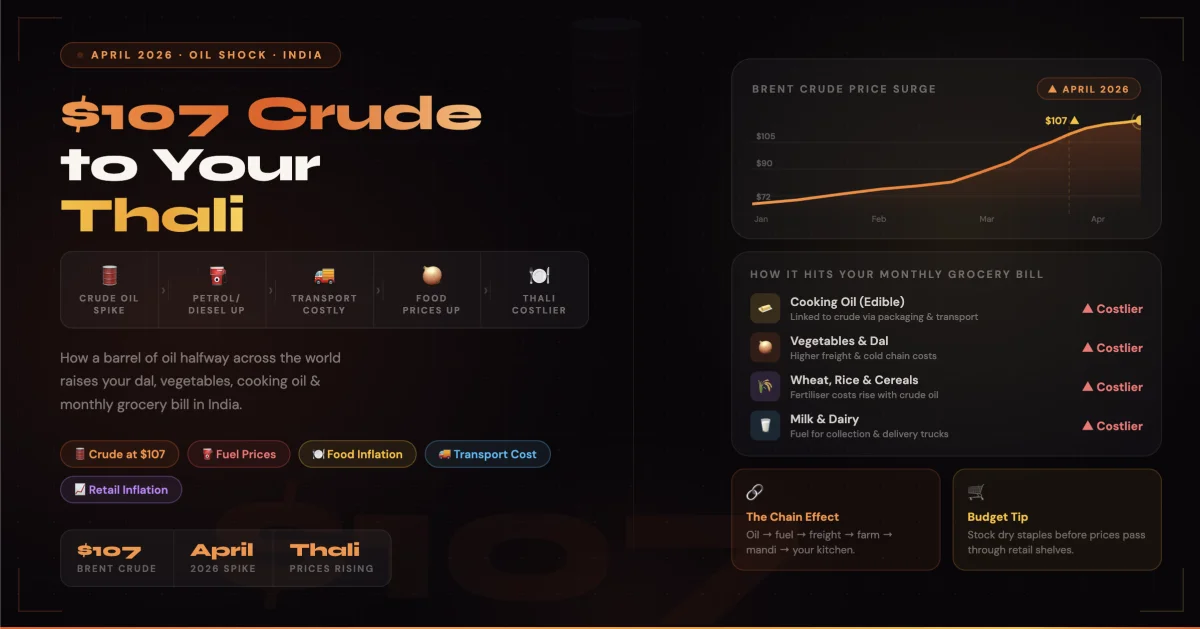
The price of that crude: approximately $107 per barrel as of April 2026.
By the time that oil is refined, transported, and used — it will have quietly added money to your petrol bill, your LPG cylinder cost, your vegetable prices, your cooking oil price, your packaged foods bill, and your monthly grocery total.
Most Indian households feel this impact every month without understanding exactly how it happened. They know things are more expensive. They don't know why. And without understanding the why, there is no way to plan for it.
This article traces the complete chain — from $107 per barrel in the Persian Gulf to the specific line items on your monthly grocery budget in India.
Why $107 Matters More to India Than to Almost Any Other Country
India imports approximately 85% of its crude oil requirement. That is not a rounding error — it means for every 100 litres of fuel refined and consumed in India, 85 litres started as imported crude.
This structural dependency makes crude oil impact on the Indian economy more severe and more direct than in countries that produce their own oil.
The United States produces more oil than it consumes — an oil price spike hurts American consumers but benefits American oil companies, creating a partial economic offset. India has no such offset. Every dollar rise in crude oil price is a pure cost with no domestic benefit.
The mathematics of India's crude exposure:
- India consumes approximately 5 million barrels of crude per day
- At $107/barrel, daily import cost: $535 million per day
- Annual crude oil import bill at $107: approximately $195 billion per year
- Every $10 rise in crude costs India: approximately ₹83,000–₹85,000 crore more annually
This money has to come from somewhere. It comes from a wider current account deficit, a weaker rupee, higher inflation, and eventually — higher prices across every category that uses energy in its production or delivery.
Which is to say: every category.
Brent Crude Price in INR — The Double Hit on Indian Households
When people track crude oil prices, they typically look at the dollar price — Brent crude at $107/barrel. For Indian households, this is only half the relevant number.
Because India buys crude in US dollars, the Brent crude price in INR is what actually determines the domestic cost impact. And this rupee-denominated price is determined by two variables moving simultaneously:
Variable 1 — The dollar price of crude: Brent at $107 vs $80 twelve months ago = a 33% increase in dollar terms.
Variable 2 — The USD/INR exchange rate: The Indian Rupee has been under significant pressure in 2026. Why is the Indian Rupee falling against the Dollar? Three connected reasons:
- Higher crude import bills require more dollars — India must sell more rupees to buy those dollars, weakening the rupee
- Foreign Institutional Investors selling Indian assets during global risk-off periods (Iran-Israel tensions, global slowdown) convert rupees to dollars — again weakening the rupee
- The US Federal Reserve's higher-for-longer interest rate policy makes dollar assets more attractive, pulling capital away from emerging markets like India
The double hit in numbers (illustrative):
Crude at $80 with USD/INR at ₹82:
₹6,560 per barrel in rupee terms.
Crude at $107 with USD/INR at ₹86:
₹9,202 per barrel in rupee terms.
That is a 40% increase in rupee cost
despite only a 33% increase in dollar cost.
The weaker rupee added an extra
7 percentage points of pain
on top of the crude price rise itself.
This is what economists call imported inflation — inflation that originates outside the country but enters through the import channel. India is particularly vulnerable to imported inflation because of its crude oil dependency and the rupee's sensitivity to global risk events.
The Transmission Chain — From Barrel to Thali, Step by Step
The journey from a crude oil barrel to your monthly grocery bill is not direct — it moves through five distinct transmission channels, each adding cost at every step.
Channel 1 — Diesel Price and the Direct Transport Cost
Diesel is refined from crude oil. When crude rises, diesel rises. And diesel is the fuel that moves every vegetable, every grain, every packaged food product from farm to mandi to distributor to retailer to your local kirana store.
Impact of diesel price on food prices — the documented relationship:
- India has approximately 1.4 crore registered trucks moving goods across the country
- Diesel accounts for 60–70% of truck operating costs
- A ₹5/litre increase in diesel raises freight rates by approximately 8–12% on a typical route
- Freight costs account for 5–15% of the final price of perishable goods like vegetables and fruits — higher for items travelling long distances (Himachali apples to Chennai, Nashik onions to Delhi)
Why vegetable prices are rising in India — transport cost is always part of the answer, even when the underlying produce is available in adequate quantity. A good tomato harvest in Andhra Pradesh does not prevent high tomato prices in Delhi if the cost of trucking them 1,500 kilometres has risen significantly.
Channel 2 — LPG Cylinder Price and Cooking Cost
LPG (Liquefied Petroleum Gas) is a direct petroleum product — propane and butane derived from crude oil refining and natural gas processing. Your cooking gas cylinder is a crude oil derivative.
LPG cylinder price today and trend:
The 14.2 kg domestic LPG cylinder
price in India has tracked crude oil
through multiple cycles:
- 2020 (crude crashed to $20): LPG was ₹594/cylinder
- 2022 (crude at $120, Russia-Ukraine): LPG crossed ₹903/cylinder
- 2024 (government cut pre-election): LPG came down to ₹803/cylinder
- 2026 (crude back at $107): LPG is under pressure to rise again — oil marketing companies (HPCL, BPCL, IOC) are absorbing losses or the government must raise prices
For a household using 1.5 cylinders per month, the difference between ₹600 and ₹950 per cylinder is ₹525 more per month — just on cooking gas alone, before counting any grocery price increases.
Check the current LPG price in your city: the official rate is updated monthly on the IOC, HPCL, and BPCL websites. Prices vary by city due to local taxes and transportation costs.
Channel 3 — Edible Oil Prices India and the Crude Connection
This channel surprises most people: edible oil prices in India are directly connected to crude oil. The connection operates through two mechanisms:
Mechanism A — Palm oil and crude correlation: Palm oil (which accounts for approximately 40% of India's vegetable oil imports) is used as a biofuel feedstock globally. When crude oil prices rise, biofuel demand for palm oil increases, pushing up global palm oil prices — which then transmits directly to Indian cooking oil prices (since India imports approximately 60% of its edible oil requirements).
Mechanism B — Production and transport costs: Even domestically produced edible oils (groundnut, mustard, sunflower) require diesel-powered farm equipment for harvesting, diesel for transportation from farm to crushing mill, and energy for the refining process. Higher crude = higher production cost = higher shelf price.
Edible oil price impact on the Indian thali: The average Indian household uses approximately 800 grams to 1 kg of cooking oil per week. A ₹30/litre increase in cooking oil price adds approximately ₹360–₹450 per month to the household grocery bill — just from this one commodity.
Channel 4 — FMCG Price Hike and Packaged Foods
Fast-Moving Consumer Goods companies — HUL, ITC, Nestle, Britannia, Dabur, Marico — manufacture products whose input costs are directly tied to crude oil:
Crude-linked FMCG inputs:
- Packaging: PET bottles, plastic pouches, plastic caps — all made from petrochemicals derived from crude oil. Packaging cost is 15–30% of total production cost for many FMCG products.
- Synthetic ingredients: Surfactants in shampoo and detergent, preservatives in packaged foods, synthetic fragrances — all petroleum derivatives.
- Energy costs: FMCG manufacturing plants run on electricity (often diesel-generated as backup) and direct fuel for heating processes.
- Last-mile delivery: Getting biscuits from a Britannia factory in Kolkata to 10 million kirana stores across India requires diesel-powered distribution fleets at every level.
FMCG price hike news pattern: When crude rises sharply, FMCG companies first absorb costs (for 1–2 quarters) and then implement price hikes (often disguised as "grammage reductions" — same price, smaller pack). The consumer pays more per kg even when the listed price hasn't changed.
Transport cost impact on FMCG: A 10% increase in diesel prices typically translates to a 1.5–3% increase in FMCG distribution costs — which flows through to retail prices within 6–12 weeks.
Channel 5 — Irrigation, Farming, and Agricultural Production Costs
This is the least visible but most fundamental channel:
Indian agriculture is diesel-dependent:
- Diesel-powered pump sets irrigate approximately 70% of India's groundwater-irrigated farmland
- Tractors, harvesters, and threshers run on diesel
- Fertiliser production (urea) uses natural gas as feedstock — which is also linked to global energy prices through the crude complex
When crude rises, farmers' input costs rise. This either reduces their margins (making farming less viable) or increases the price they need to recover costs — both outcomes ultimately result in higher food prices at the retail level.
The specific oil price and inflation relationship in India: Research from the Reserve Bank of India has documented that a 10% increase in global crude oil prices leads to a 0.4–0.6 percentage point increase in India's Consumer Price Index (CPI) inflation over a 3–6 month period — with food inflation showing particularly strong transmission.
The Monthly Grocery Budget Impact — Real Numbers for Middle-Class India
⚠️ All figures below are illustrative estimates based on publicly available data at time of writing. Actual prices vary by city, locality, season, and household composition. These are approximations for educational purposes only.
Average monthly expenses for a family of 4 in India (urban middle class, tier-1 city) in a low-crude vs high-crude environment:
Monthly grocery budget for middle class — typical breakdown, illustrative:
- Grains and pulses (atta, rice, dal):
Low crude: ₹2,200 | High crude: ₹2,600
Difference: +₹400 - Vegetables and fruits:
Low crude: ₹3,500 | High crude: ₹4,400
Difference: +₹900 (highest impact category — perishables have the highest transport cost percentage) - Edible oil (4–5 litres/month):
Low crude: ₹800 | High crude: ₹1,100
Difference: +₹300 - LPG cylinder (1.5 cylinders/month):
Low crude: ₹900 | High crude: ₹1,350
Difference: +₹450 - Packaged foods, dairy, beverages:
Low crude: ₹3,200 | High crude: ₹3,700
Difference: +₹500 (FMCG hikes lag by 2–3 months but eventually arrive) - Household cleaning and personal care:
Low crude: ₹1,500 | High crude: ₹1,750
Difference: +₹250 (petrochemical-based inputs)
Total monthly grocery and household essentials increase during a crude spike: approximately ₹2,800 per month for a middle-class family of 4 in a tier-1 Indian city.
That is ₹33,600 per year in additional household expenditure — purely from the crude oil price channel — without any salary increase to compensate.
For a household earning ₹70,000/month in-hand, this represents approximately a 4% real income reduction just from the grocery and household essentials channel of crude-driven inflation. Add petrol, commuting costs, and auto/cab fare increases — and the total real income impact is closer to 6–8% of monthly take-home salary.
How to Reduce Household Expenses During Inflation — Practical Steps
You cannot control crude oil prices. You can control your household's response to them. Here are the specific, actionable steps that reduce the impact of crude-driven inflation on your monthly grocery budget:
1. Switch seasonal and substitute
where quality is comparable:
During high crude periods,
transport-intensive vegetables
(those shipped long distances —
capsicum, broccoli, exotic produce)
see the sharpest price spikes.
Local, seasonal vegetables have
lower transport cost components.
A household that substitutes
imported capsicum for local
green chillies and long-distance
broccoli for local palak
during crude spikes saves
meaningfully without sacrificing nutrition.
2. Buy edible oil in larger packs:
Edible oil prices during crude spikes
tend to rise and then partially
correct as global prices stabilise.
If you have storage, buying a 5-litre
or 15-litre tin of cooking oil
during a price dip locks in
a lower rate for 2–3 months.
3. Optimise LPG consumption:
Pressure cooking reduces cooking time
and therefore gas consumption
by 30–40% for the same meals.
Matching flame size to vessel size
and avoiding leaving burners on
after cooking completes saves
meaningful gas across a month.
4. Switch to PNG if available:
If your city has Piped Natural Gas
infrastructure (IGL in Delhi NCR,
MGL in Mumbai, Gujarat Gas in Gujarat),
PNG is significantly cheaper per unit
than LPG and is less directly
impacted by crude oil spikes —
being primarily domestic gas-priced.
5. Time grocery purchases
with market rhythms:
Vegetable prices in India are
highest on Mondays
(first market day after Sunday closure)
and lowest on Wednesday–Thursday
(mid-week when supply is fresh
and retailers are moving stock).
Buying vegetables on Thursday
instead of Monday consistently
saves 10–15% on the same basket.
6. Build a price baseline
so you know when to stock up:
Most households have no reference point
for whether today's grocery prices
are high or low relative to
the recent average.
Without this baseline, you cannot
make informed stock-up decisions.
How to Track Daily Expenses for a Small Family During Inflation
The households that manage inflation best are not the ones with the highest incomes. They are the ones that know their numbers.
When crude spikes and grocery prices rise, households without expense tracking experience this as a vague, uncomfortable feeling that "things are more expensive" — but they cannot quantify how much more, in which categories, or by how much their total monthly spend has changed.
This vagueness prevents action. You cannot reduce what you cannot measure.
How to track daily expenses for a small family — the simple system:
- Log every grocery purchase by category — vegetables, oils, grains, packaged foods, LPG — separately
- Record the price per unit or per kg for items you buy regularly — not just the total bill amount
- Review monthly totals by category at month end
- Compare month-on-month — which category increased most? Is it tracking your expectation based on crude prices?
This system gives you two things: early warning when inflation is hitting a specific category unusually hard, and the data to make targeted adjustments rather than across-the-board cuts.
Use RozHisab to log every grocery expense by category throughout the month. See exactly how much your vegetable budget, cooking oil spend, and LPG cost have changed from last month to this month — and whether your total household grocery budget is staying within your planned amount or drifting upward with the crude oil spike.
When you can see that your vegetable spend went from ₹3,200 to ₹4,100 in one month — you know where the crude oil impact is hitting hardest in your specific household, and you can make targeted decisions: substitute, reduce, or consciously accept the increase and adjust elsewhere in the budget.
The Bigger Picture — Crude Oil Impact on the Indian Economy Beyond Groceries
The grocery impact is the most immediate and personal effect of a crude spike. But the crude oil impact on the Indian economy extends further — and understanding these broader effects helps predict what comes next for household finances:
Current account deficit widens: Higher oil import costs mean India pays more to the rest of the world. This widens the current account deficit — a measure of how much more India spends abroad than it earns. A wider deficit puts downward pressure on the rupee, which then feeds back into higher import costs — a cycle that can become self-reinforcing.
RBI faces a dilemma: The Reserve Bank of India combats inflation by raising interest rates. But raising rates during a global growth slowdown could further weaken domestic consumption. If the RBI raises rates to control crude-driven inflation, home loan EMIs, car loan EMIs, and personal loan EMIs all rise — adding to household financial pressure beyond just the grocery bill.
Government fiscal pressure: The government has limited tools to shield consumers from crude spikes. Cutting excise duty on petrol and diesel (as done in 2022) costs ₹1 lakh crore+ in foregone revenue. Increasing LPG subsidies costs more. These are short-term tools with long-term fiscal consequences. Eventually, the crude price increase passes through to consumers — the only question is timing.
Corporate earnings squeezed: Companies across aviation, auto, logistics, FMCG, and manufacturing see margin pressure from higher input and energy costs. If they absorb costs, earnings fall. If they pass on costs, consumers pay more. Either way, the crude spike affects the broader economy within 2–3 quarters.
What This Means for Your Monthly Budget Right Now
Three practical actions based on the current crude environment:
Action 1 — Build a 10–15% buffer
into your monthly grocery budget:
If your normal grocery budget is ₹12,000,
budget ₹13,200–₹13,800 for the next
3–4 months while crude stays elevated.
This prevents the monthly budget
from going into deficit
from grocery overspend alone.
Action 2 — Audit your LPG and
transport costs specifically:
These are the two most directly
crude-linked household expense categories.
Is there a CNG or PNG option for cooking?
Can you reduce Ola/Uber rides
during peak surge pricing?
Small changes in these categories
offset part of the grocery increase.
Action 3 — Track actual vs budgeted
grocery spend every week, not every month:
Monthly reviews catch the damage
after it has already happened.
Weekly reviews catch it mid-month
when you can still adjust
the remaining 2 weeks of spending.
Use RozHisab to set your monthly grocery budget and track daily expenses against it in real time. When crude is at $107 and groceries are rising, knowing your running total on the 15th of the month is the difference between finishing within budget and discovering the overrun on the 31st.
The barrel is $107. Your thali costs more than last year. The chain connecting these two facts is real, documented, and ongoing. Understanding it is the first step — tracking your household's specific exposure to it is the step that actually protects your budget.
👉 Track every grocery expense and see your real monthly food inflation at RozHisab — free, built for Indian families, no complexity required.
Quick Reference — From Crude Barrel to Your Thali
- 🛢️ Crude oil India dependency: 85% imported — every dollar rise in crude is a pure cost with no domestic offset
- 💱 Brent crude price in INR: Double hit — dollar price + weaker rupee = 40% INR cost increase vs 33% dollar increase
- 🚛 Diesel and vegetable prices: ₹5/litre diesel rise = 8–12% freight rate increase = 5–15% food price increase in 4–8 weeks
- 🔥 LPG cylinder impact: 1.5 cylinders/month family pays ₹450 more at peak crude prices
- 🌻 Edible oil prices India: Palm oil-crude link + transport costs = ₹300–₹400 more per month for a typical household
- 📦 FMCG price hike: Petrochemical packaging + transport = 1.5–3% price rise with 2–3 month lag after crude spike
- 💰 Total household impact: ~₹2,800/month additional for middle-class family of 4 during crude at $107
- 📊 Track your specific impact: Log grocery categories on RozHisab to see which channel hits your household hardest
📌 Disclaimer: This article is for educational and informational purposes only. All crude oil prices, grocery estimates, LPG rates, inflation figures, and budget examples are approximate, illustrative, and subject to change. Economic relationships described are based on general principles and publicly available research — actual impacts vary by household, city, season, and market conditions. Nothing in this article constitutes financial, investment, or policy advice. RozHisab is a budgeting and expense tracking tool — not an economic or financial advisory service.
Track your own finances — free forever
Use RozHisab to apply everything in this article to your actual spending and savings.
Start Tracking Free →