Tax Saving Options in India 2026 — Complete Guide to PPF, ELSS, NPS, FD, Insurance and More
Here is a number most salaried Indians never calculate:
A person earning ₹10 lakh per year who uses zero tax-saving instruments pays approximately ₹1,12,500 in income tax. The same person, using all available deductions correctly, can bring their taxable income down to ₹5.5 lakh — and pay close to zero tax.
Same salary. Same employer. ₹1,12,500 difference — legally.
India's tax code is genuinely generous with deductions. The problem is that most people either don't know what's available, invest in the wrong instruments, or miss the deadline every March and panic-invest in whatever their insurance agent recommends.
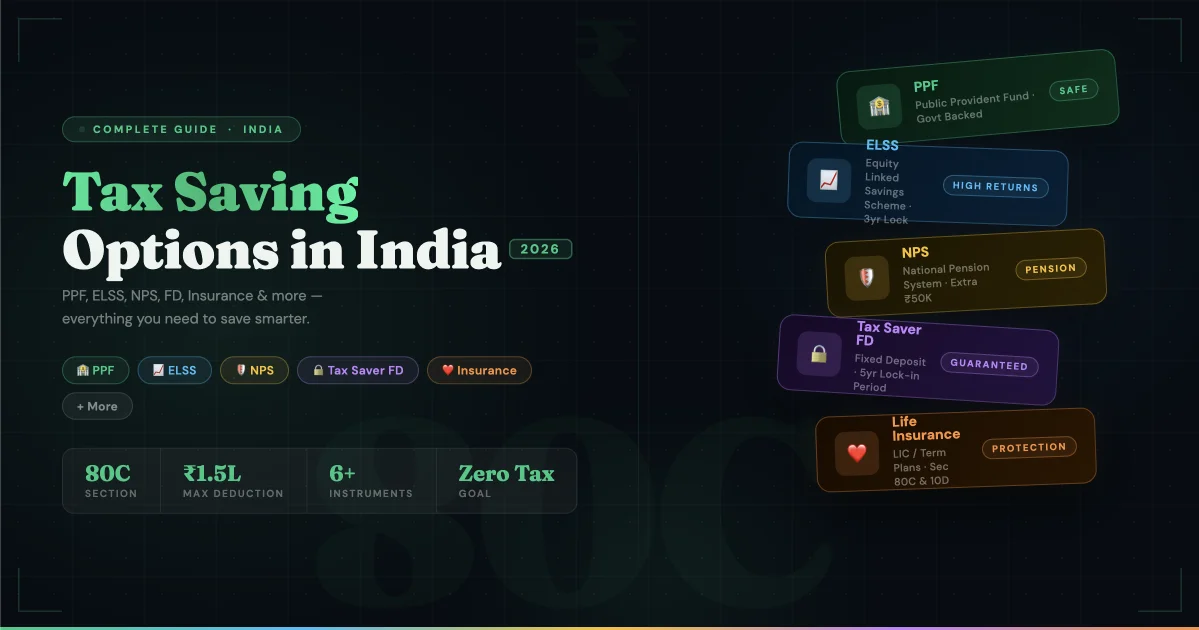
This guide covers every major tax saving option available in India in 2026 — PPF, ELSS, NPS, tax saving FDs, term life insurance, health insurance, and more — with the actual numbers, limits, and which option is best for which type of person.
And at the end: how tracking your savings and investments throughout the year — not just in March — saves you from bad last-minute decisions that cost more than the tax they save.
The Foundation — Understanding Section 80C
Before getting into specific instruments, understand the framework:
Section 80C of the Income Tax Act allows you to deduct up to ₹1,50,000 from your taxable income every financial year by investing in approved instruments.
If you're in the 30% tax bracket, fully utilising 80C saves you ₹46,800 in tax (₹1,50,000 × 30% + cess).
If you're in the 20% tax bracket, it saves you ₹31,200.
If you're in the 10% tax bracket, it saves you ₹15,600.
This is free money sitting on the table. Every rupee of 80C you don't use is a rupee of avoidable tax.
Beyond 80C, there are additional deductions under 80D (health insurance), 80CCD(1B) (NPS), 24B (home loan interest), and others — covered below. The total possible deduction for a salaried individual can exceed ₹3.5–₹4 lakh per year if all are used correctly.
⚠️ Old vs New Tax Regime: From FY 2023-24, the New Tax Regime became the default. The New Regime has lower slab rates but most deductions including 80C, 80D, and HRA are not available. The Old Regime allows all deductions covered in this article. If your total deductions exceed ₹3.75 lakh, the Old Regime is almost always better. Calculate both before deciding.
Option 1 — PPF (Public Provident Fund) — Best for Long-Term Tax-Free Savings
What Is a PPF Account?
The Public Provident Fund (PPF) is a government-backed savings scheme that offers a guaranteed, tax-free return with full sovereign guarantee — meaning the Government of India backs every rupee in your PPF account.
Key PPF Account Details for 2026:
- PPF Account Interest Rate: 7.1% per annum (revised quarterly by government — has ranged from 7.1% to 8.7% historically)
- Minimum Investment: ₹500 per year
- Maximum Investment: ₹1,50,000 per year (exactly the 80C limit)
- Lock-in Period: 15 years (partial withdrawal allowed from year 7)
- Tax Treatment: EEE — Exempt-Exempt-Exempt
EEE means the investment is tax-exempt, the interest earned is tax-exempt, and the maturity amount is tax-exempt. This is the best tax treatment available on any financial instrument in India.
PPF Account — Where to Open: Any post office, SBI, or most major banks (HDFC, ICICI, Axis, PNB). Can be opened and managed fully online through your bank's net banking. Takes 15 minutes to set up.
PPF Fund Growth Example:
₹1,50,000 invested every year for 15 years at 7.1% = approximately ₹40.68 lakh at maturity — entirely tax-free.
Your total investment: ₹22.5 lakh. Tax-free gain: ₹18+ lakh.
✅ Best for: Conservative investors, government employees, people in higher tax brackets who want guaranteed returns, and anyone building a long-term corpus with zero market risk.
❌ Not ideal for: People needing liquidity — the 15-year lock-in is real. Also, at 7.1%, PPF returns are lower than equity over 15+ year horizons.
Option 2 — ELSS (Equity Linked Savings Scheme) — Best Tax Saving Investment for Wealth Creation
What Is ELSS?
An Equity Linked Savings Scheme (ELSS) is a type of mutual fund that invests primarily in equities (stocks) and qualifies for 80C deduction up to ₹1,50,000. It is the only mutual fund category with a tax benefit.
Key ELSS Details:
- Lock-in Period: 3 years — the shortest lock-in of any 80C instrument
- Expected Returns: 12–15% annually over 5–10 year periods (market-linked, not guaranteed)
- Tax Treatment: Investment is tax-exempt (80C). Returns above ₹1 lakh per year are taxed at 10% LTCG — still far better than FD or savings account interest taxed at slab rate
- Minimum Investment: ₹500 per month via SIP
ELSS Tax Saving — The Math:
₹1,50,000 invested in ELSS for 10 years at 13% average return = approximately ₹50.96 lakh.
Same ₹1,50,000 in a Tax Saving FD at 7% for 10 years = approximately ₹29.5 lakh (before tax on interest).
ELSS outperforms tax saving FD by ₹20+ lakh over 10 years — in addition to giving the same 80C deduction.
Best ELSS Funds in India 2026 (by consistent track record):
- Mirae Asset Tax Saver Fund
- Quant Tax Plan
- Canara Robeco Equity Tax Saver
- DSP Tax Saver Fund
- Axis Long Term Equity Fund
✅ Best for: Anyone under 45 with a 5+ year horizon who wants to both save tax AND build wealth. The combination of shortest lock-in + highest expected return makes ELSS the most powerful 80C instrument for wealth creation.
❌ Not ideal for: Investors close to retirement or those who cannot tolerate short-term portfolio volatility.
Option 3 — Tax Saving Fixed Deposit — Best for Risk-Averse Investors
What Is a Tax Saving Fixed Deposit?
A Tax Saving Fixed Deposit is a special FD with a mandatory 5-year lock-in that qualifies for Section 80C deduction up to ₹1,50,000. It is offered by all major banks.
Key Tax Saving FD Details:
- Lock-in: 5 years — no premature withdrawal allowed
- Interest Rate: 6.5–7.5% depending on bank (senior citizens get 0.5% extra)
- Tax Treatment: Investment is 80C deductible. Interest earned is fully taxable at your income slab — this is the critical downside
- Maximum Deduction: ₹1,50,000 per year
HDFC Tax Saving FD: HDFC Bank offers a 5-year tax saving FD at approximately 7.0% for general customers and 7.5% for senior citizens. Apply via HDFC Net Banking under Fixed Deposits → Tax Saving FD. Takes under 5 minutes.
5 Year Fixed Deposit Tax Free — Important Clarification:
The investment in a tax saving FD is tax-free (80C deduction).
The interest earned is NOT tax-free — it is added to your income and taxed at your slab rate.
This makes tax saving FDs significantly less efficient than PPF or ELSS for investors in the 20–30% tax bracket.
✅ Best for: Senior citizens (higher FD rates + lower tax bracket), conservative investors who need guaranteed returns, people who have already maxed ELSS and PPF and need to fill remaining 80C limit.
❌ Not ideal for: Young investors in the 20–30% tax bracket — the taxable interest significantly erodes real returns.
Option 4 — NPS (National Pension System) — Best for Additional Tax Saving Beyond 80C
What Is the National Pension System?
The National Pension System (NPS) — often referred to as National Payment System in common usage, though correctly it is the National Pension System — is a government-regulated retirement savings scheme that offers tax benefits beyond the standard 80C limit.
NPS Tax Benefits — Two Layers:
Layer 1 — Within 80C:
Contributions up to ₹1,50,000 qualify under 80C (combined with PPF, ELSS, etc.)
Layer 2 — Exclusive NPS Benefit under 80CCD(1B):
An additional ₹50,000 deduction exclusively for NPS, over and above the ₹1,50,000 80C limit. This is a deduction no other instrument provides.
For a 30% bracket taxpayer, this extra ₹50,000 deduction saves an additional ₹15,600 in tax every year.
Total possible NPS deduction: ₹2,00,000 per year (₹1.5L under 80C + ₹50K under 80CCD(1B)).
Key NPS Details:
- Lock-in: Until age 60 (this is a retirement instrument — long commitment)
- Returns: Market-linked — depends on your chosen asset allocation (equity, corporate bonds, government bonds)
- At Maturity: 60% of corpus is tax-free on withdrawal. 40% must be used to purchase an annuity (pension) — annuity income is taxable
- Account Types: Tier 1 (tax benefit, locked till 60) and Tier 2 (no tax benefit, fully liquid — acts like a mutual fund)
How to Open NPS Account: Via eNPS portal (enps.nsdl.com), any bank's net banking, or through your employer's HR if they offer NPS as a salary component.
✅ Best for: Salaried individuals who have already maxed 80C and want additional tax deduction. Self-employed professionals in the 30% bracket for whom the extra ₹50K deduction is high value. Anyone building a retirement corpus systematically.
❌ Not ideal for: People who need liquidity before age 60. The lock-in is the longest of any instrument covered here.
Option 5 — Term Life Insurance — Tax Saving + Essential Financial Protection
What Is Term Life Insurance and Why It's the Only Life Insurance Worth Buying for Tax Saving
Term life insurance is pure life cover — you pay a premium, and if you die during the policy term, your family receives the sum assured. There is no maturity benefit, no savings component, no investment return. Just protection.
This simplicity is precisely why term insurance is the best life insurance product for tax saving. The premium is dramatically lower than endowment plans, money-back policies, or ULIPs — which means more coverage per rupee of premium, and more of your money available for actual investments like ELSS and PPF.
Term Life Insurance — Tax Benefit:
Premiums paid qualify for Section 80C deduction (within the ₹1,50,000 limit).
Death benefit received by family is fully tax-free under Section 10(10D).
Term Life Insurance Rates in India 2026 — Approximate:
- ₹1 crore cover, 30-year-old non-smoker male, 30-year term: ₹8,000–₹12,000/year
- ₹1 crore cover, 35-year-old non-smoker male, 25-year term: ₹11,000–₹16,000/year
- ₹50 lakh cover, 25-year-old female, 35-year term: ₹5,500–₹8,000/year
Cheapest Term Life Insurance in India: Competitive options include LIC Tech Term, HDFC Life Click2Protect, ICICI Prulife iProtect Smart, Tata AIA Sampoorna Raksha, and Max Life Smart Secure Plus. Compare at Policybazaar or Ditto Insurance for personalised quotes.
Affordable Life Insurance — The Right Frame:
At ₹800–₹1,200/month, a ₹1 crore term plan is the cheapest form of financial security available to an Indian family. The question is not whether you can afford term insurance — it's whether your family can afford for you NOT to have it.
✅ Best for: Every earning Indian with dependents. Non-negotiable if you have a home loan, spouse, children, or parents dependent on your income.
⚠️ Avoid ULIPs for tax saving: Unit Linked Insurance Plans (ULIPs) combine insurance and investment — and do both poorly. High charges (premium allocation, fund management, mortality) destroy returns in the first 5–7 years. Buy term insurance for protection. Buy ELSS for investment. Never mix the two.
Option 6 — Health Insurance (Section 80D) — Tax Saving OUTSIDE the 80C Limit
What Is Section 80D?
Section 80D allows deduction of health insurance premiums paid for yourself, spouse, children, and parents — and this is completely separate from Section 80C. It does not eat into your ₹1,50,000 80C limit.
Section 80D Limits for 2026:
- Self + spouse + children (below 60): Up to ₹25,000 deduction
- Parents (below 60): Additional up to ₹25,000 deduction
- Parents (above 60 — senior citizens): Additional up to ₹50,000 deduction
- Maximum possible 80D deduction: ₹75,000/year (if both you and your parents are covered and parents are senior citizens)
For a 30% bracket taxpayer with senior citizen parents, fully utilising 80D saves an additional ₹23,400 in tax every year — on top of 80C savings.
Private Health Insurance in India — What to Buy:
- Star Health Family Health Optima
- Niva Bupa Reassure 2.0
- HDFC ERGO Optima Secure
- Care Supreme Plan
A family floater policy covering a family of 4 with ₹10 lakh sum insured typically costs ₹18,000–₹30,000/year — within the 80D limit and providing genuine medical protection.
✅ Best for: Everyone. Health insurance is not optional in 2026 — a single hospitalisation without insurance can cost ₹2–₹5 lakh. The 80D deduction is a bonus, not the primary reason to buy it.
Option 7 — High Interest Savings Options for Short-Term Tax Efficiency
NSC (National Savings Certificate)
NSC is a post office savings instrument with a 5-year lock-in that qualifies for 80C deduction.
- Interest Rate: 7.7% per annum (revised quarterly)
- Tax Treatment: Investment is 80C deductible. Interest is taxable but automatically reinvested NSC interest also qualifies for 80C deduction in subsequent years — a compounding tax benefit unique to NSC
- Minimum: ₹1,000. No maximum.
Sukanya Samriddhi Yojana (SSY) — For Daughters
If you have a daughter below age 10, SSY is the best possible 80C instrument.
- Interest Rate: 8.2% per annum — highest guaranteed rate of any government scheme
- Tax Treatment: Full EEE — investment, interest, and maturity all tax-free
- Lock-in: Until daughter turns 21 (partial withdrawal at 18 for education)
- Maximum: ₹1,50,000 per year per daughter
SSY + ELSS is the most powerful 80C combination for a parent with a daughter under 10.
Senior Citizens Savings Scheme (SCSS)
For individuals above 60:
- Interest Rate: 8.2% per annum — one of the highest guaranteed rates available to retirees
- Qualifies for 80C deduction
- Maximum deposit: ₹30 lakh per individual
- Interest is paid quarterly — making it a retirement income instrument
The Complete Tax Saving Toolkit — How Much You Can Save
Here is the maximum possible tax deduction available to a salaried individual using all instruments:
- Section 80C (PPF + ELSS + Tax Saving FD + Term Insurance Premium): ₹1,50,000
- Section 80CCD(1B) (NPS additional contribution): ₹50,000
- Section 80D (Health insurance — self + senior citizen parents): ₹75,000
- Section 24B (Home loan interest deduction): ₹2,00,000
- Standard Deduction (for salaried): ₹50,000
- HRA Exemption (if renting): Up to ₹1,00,000+ depending on city and salary
Total possible deductions: ₹5.75 lakh+ per year — before HRA.
For someone earning ₹15 lakh per year using all deductions correctly, taxable income can fall to ₹9–₹10 lakh — saving ₹1.5–₹2 lakh in tax annually.
Which Tax Saving Option Is Right for You — A Quick Framework
If you are 25–35, salaried, and have 15+ years to invest:
→ ELSS first (best return + shortest lock-in + 80C benefit)
→ NPS second (extra ₹50K deduction under 80CCD(1B))
→ Term insurance (mandatory if you have dependents — premiums are 80C deductible)
→ Health insurance (80D, separately)
If you are conservative or approaching retirement (50+):
→ PPF (guaranteed, tax-free, government-backed)
→ SCSS if above 60 (8.2% guaranteed quarterly income)
→ NSC (stable returns, 80C eligible)
→ Tax Saving FD (if you prefer bank instruments)
If you have a daughter below age 10:
→ Sukanya Samriddhi Yojana (8.2%, full EEE, best in class)
→ ELSS for remaining 80C limit
If you need maximum tax saving beyond 80C:
→ NPS (₹50K extra deduction)
→ Health insurance for parents (up to ₹50K extra under 80D)
→ Home loan (₹2 lakh interest deduction under 24B)
⚠️ The Tax Saving Mistake That Costs Indians Every March
Every year, the same thing happens across India in February and March:
HR sends a "submit your investment proofs" deadline reminder. Panic sets in. People rush to invest ₹1,50,000 in 2 weeks. Insurance agents call with ULIPs and endowment plans offering "guaranteed returns + tax saving." People invest in products they don't understand, locked in for 10–20 years, with poor returns — just to avoid tax.
The result: the tax is saved, but ₹1–₹2 lakh is trapped in a bad product for a decade.
The correct approach is to plan your 80C investments in April — the start of the financial year — and invest through monthly SIPs over 12 months. Not a lump sum in March.
Benefits of investing from April:
- ELSS SIPs spread market risk over 12 months instead of lump-sum in volatile March
- No pressure to make rushed decisions under a deadline
- PPF and NPS contributions earn interest for the full year instead of just 1–2 months
- You have time to compare options and choose the right instrument
Use RozHisab to set your annual tax saving target in April, track your monthly SIP contributions, and see — throughout the year — whether you're on track to fully utilise your 80C limit. No more March panic. No more bad last-minute decisions.
How to File Your Taxes Online in India — Quick Overview
Once your investments are in order, filing taxes online in India is straightforward:
- Portal: incometax.gov.in — the official Income Tax e-filing portal
- Deadline: July 31 of each year for individuals (without audit)
- Form: ITR-1 (Sahaj) for salaried with income below ₹50 lakh. ITR-2 for capital gains from stocks/mutual funds
- Documents needed: Form 16 (from employer), AIS/TIS (Annual Information Statement — download from portal), investment proofs (PPF passbook, ELSS statements, insurance premium receipts)
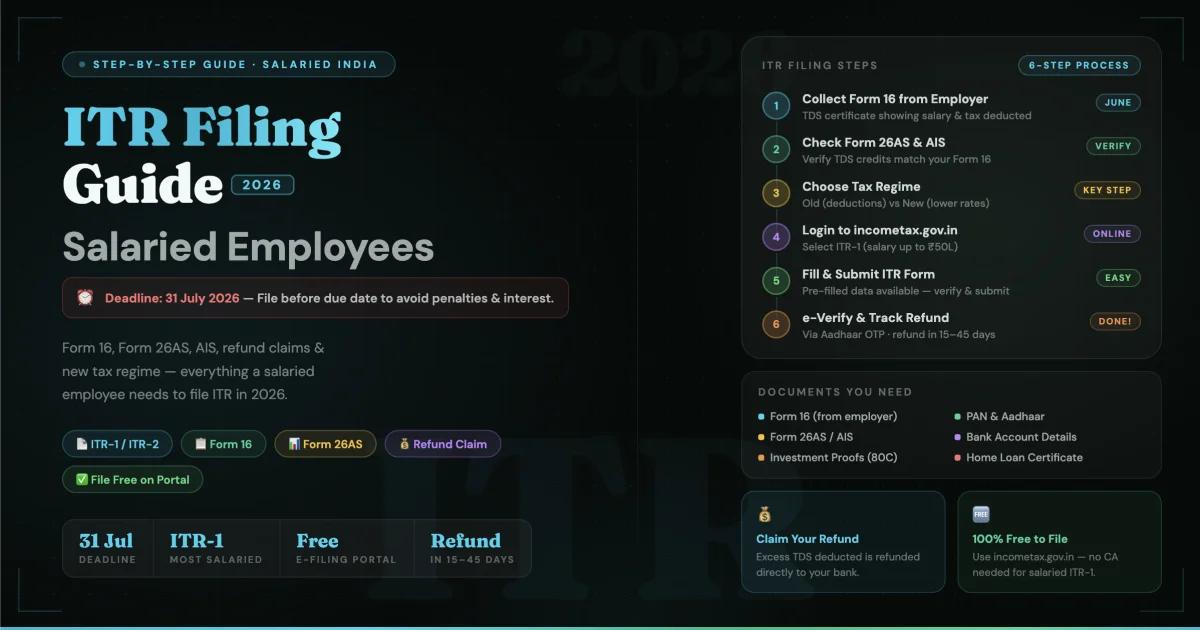
- Tax Return: If TDS deducted exceeds your actual tax liability, you get a tax refund directly to your Aadhaar-linked bank account — typically within 15–45 days of filing
Tax Relief Available: Section 87A provides a rebate of up to ₹12,500 for taxable income up to ₹5 lakh (old regime) and up to ₹25,000 for taxable income up to ₹7 lakh (new regime). This means a person with taxable income up to ₹7 lakh under the new regime effectively pays zero tax.
Track Your Tax Saving All Year — Not Just in March
The biggest gap in most Indians' tax planning is not knowledge — it's tracking.
They know about 80C. They know about ELSS and PPF. But in August, they have no idea how much they've invested so far. In December, they don't know how much 80C room they have left. In March, they guess — and usually either under-invest (leaving tax savings on the table) or panic-invest in the wrong products.
RozHisab helps you track every investment contribution throughout the year alongside your income and expenses. Set your annual 80C target. Log every PPF deposit, ELSS SIP, and NPS contribution. See your running total against the ₹1,50,000 limit in real time.
When you can see the number clearly — "I've invested ₹94,000 of my ₹1,50,000 80C limit so far" — you make better decisions. You invest the right amount in the right product at the right time. You don't panic in March.
Tax saving is not a once-a-year activity. It's a 12-month habit.
👉 Start tracking your investments and tax saving progress for free at RozHisab — because the best tax plan is the one you actually execute throughout the year.
Quick Reference — Best Tax Saving Option for Every Profile
- 📈 Best for wealth creation + tax saving: ELSS (3-year lock-in, 12–15% expected returns, 80C eligible)
- 🏦 Best guaranteed tax-free return: PPF (7.1%, EEE, 15-year, government-backed)
- 👧 Best for parents of daughters: Sukanya Samriddhi Yojana (8.2%, full EEE)
- 🏖️ Best for retirement + extra deduction: NPS (additional ₹50K under 80CCD(1B))
- 🏥 Best outside 80C limit: Health Insurance (up to ₹75,000 under 80D)
- 🛡️ Best life protection + 80C: Term Life Insurance (cheapest premium, highest cover)
- 🏛️ Best for senior citizens: SCSS (8.2%, quarterly income, 80C eligible)
- 🔒 Best risk-free 5-year option: Tax Saving FD or NSC (guaranteed, 80C eligible)
Track your own finances — free forever
Use RozHisab to apply everything in this article to your actual spending and savings.
Start Tracking Free →