Strait of Hormuz — Why the Iran-Israel War Is Crashing World Stock Markets and What It Means for India
⚠️ Disclaimer: The information provided in this article is for general educational and informational purposes only. It does not constitute financial advice, investment recommendations, tax advice, or any solicitation to buy, sell, or hold any financial instrument, security, or product. All examples, numbers, interest rates, stock prices, and return figures mentioned are illustrative or historical in nature and do not guarantee future results. Investments in stocks, mutual funds, IPOs, commodities (gold, silver), and other financial instruments are subject to market risk. Past performance is not indicative of future returns. Tax laws and financial regulations mentioned are based on information available at the time of writing and may have changed. Readers are strongly advised to consult a SEBI-registered investment advisor, certified financial planner, or qualified tax professional before making any financial or investment decisions. RozHisab is a personal finance tracking and budgeting tool — it is not a SEBI-registered investment advisory service and does not provide investment advice.
You opened your trading app this morning. Everything is red.
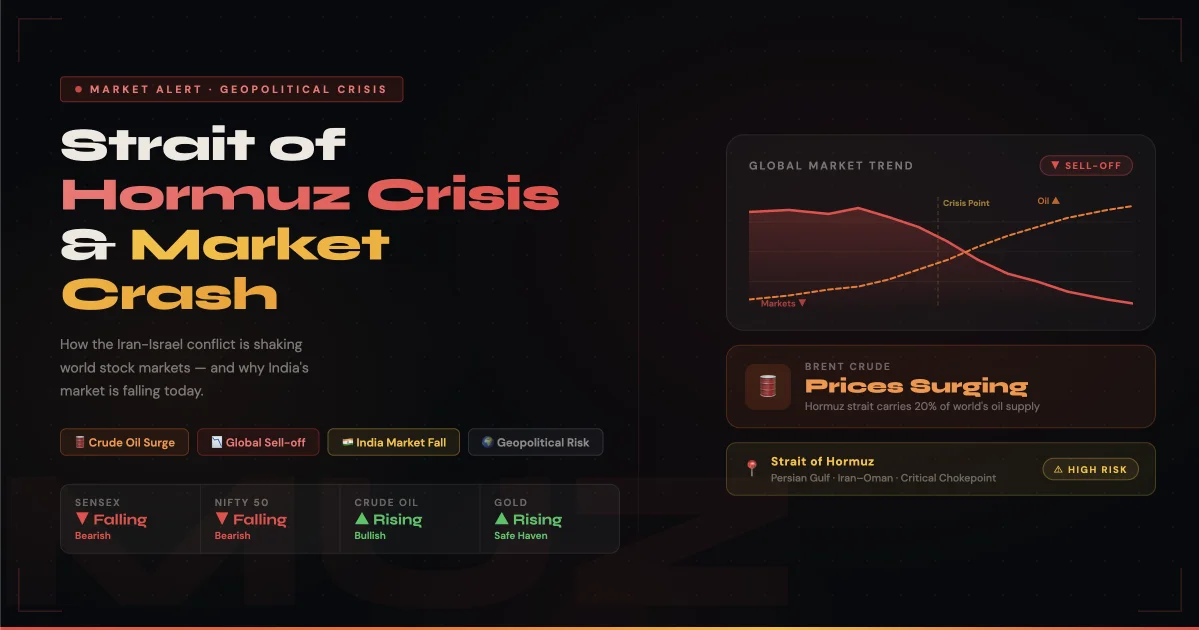
Sensex down 1,200 points. Nifty breaching support levels. Crude oil spiking. The rupee weakening. Global markets — Wall Street, London, Tokyo, Frankfurt — all falling simultaneously.
And the news headlines all say the same thing: Iran. Israel. Strait of Hormuz. Escalation.
If you've been searching "reason behind today's market fall" or "why are markets falling today" — this article gives you the complete answer. Not a headline. Not a 60-second video. The actual mechanism — from a narrow strip of water in the Persian Gulf to your portfolio going red in Mumbai or Delhi.
And more importantly: what smart investors are doing about it.
First — What Exactly Is the Strait of Hormuz?
Strait of Hormuz Pronunciation
Before the geography — because this comes up constantly in searches:
Strait of Hormuz is pronounced: "Strait of Hor-MOOZ"
The 'z' at the end is pronounced like a 'z', not silent. Hor-mooz.
You'll sound informed in every conversation about it from here on.
Where Is the Strait of Hormuz?
The Strait of Hormuz is a narrow waterway — just 54 kilometres wide at its narrowest point — that connects the Persian Gulf to the Gulf of Oman and then to the Arabian Sea.
On one side: Iran. On the other: Oman and the UAE.
It looks insignificant on a world map. It is anything but.
Through this 54-kilometre chokepoint passes approximately 20–21 million barrels of crude oil every single day — roughly 20% of all global oil trade and 25% of all global liquefied natural gas (LNG) trade.
Every oil tanker leaving Saudi Arabia, Iraq, Kuwait, UAE, Qatar, and Iran itself must pass through the Strait of Hormuz. There is no alternative route of comparable capacity. The nearest bypass — the Petroline pipeline across Saudi Arabia — carries only a fraction of Hormuz's volume.
This is why a conflict between Israel and Iran — two countries that don't even share a border — can simultaneously crash stock markets in Mumbai, London, New York, and Tokyo.
The Iran-Israel War — Why the Strait of Hormuz Is at the Centre
Iran has repeatedly signalled — and in past escalations has partially acted on — its ability to disrupt or close the Strait of Hormuz in the event of a major military conflict.
Iran's strategic position is unique: its coastline runs along the entire northern shore of the Strait. It has anti-ship missiles, naval mines, fast attack boats, and submarine capabilities specifically positioned to threaten tanker traffic through the strait.
What Iran has done historically in the Strait:
- 2019: Iran seized the British-flagged tanker Stena Impero in the Strait of Hormuz during US-Iran tensions
- 2019: Multiple oil tankers were attacked near the strait — the US blamed Iran
- 2023–2024: Iran-backed Houthi forces in Yemen began attacking commercial shipping in the Red Sea — a direct preview of what Hormuz disruption could look like
- 2024: Iran launched a direct missile and drone attack on Israel for the first time in history — crossing a threshold that had never been crossed before
In 2026, as Israel-Iran exchanges escalate further, global oil markets are pricing in the risk that the world's most critical oil chokepoint could be disrupted — even partially, even temporarily.
And that pricing-in is exactly why your portfolio is red today.
The Exact Chain Reaction — From Hormuz to Your Portfolio
Here is the step-by-step mechanism that connects an Iran-Israel missile exchange to a Sensex fall in India. This is the answer to "reason for fall in market today."
Step 1 — Iran-Israel escalation news breaks
Missiles fired. Airstrikes reported. "World War 3" trends globally.
News spreads in seconds across financial terminals worldwide.
Step 2 — Oil traders immediately price in Hormuz risk
The moment Hormuz disruption becomes a possibility — not a certainty,
just a possibility — crude oil traders buy futures contracts
aggressively. Brent crude spikes. In serious
escalation scenarios, crude has moved $5–$15 per barrel
within hours of major news.
Step 3 — India's import bill explodes mathematically
India imports 85% of its crude oil. Every $10 rise
in Brent crude costs India approximately ₹15,000 crore
more per year in import payments. This widens India's
current account deficit, puts pressure on the rupee, and signals
incoming inflation — all simultaneously.
Step 4 — Foreign Institutional Investors (FIIs) sell India
When global risk spikes, FIIs move money out of emerging markets
like India into safe-haven assets — US treasuries, gold, Swiss
francs. This selling is mechanical and fast. Billions of
rupees of Indian equities are sold within hours, pushing
Sensex and Nifty down regardless of India's domestic fundamentals.
Step 5 — Domestic retail investors panic-sell
Seeing FII selling and red screens, retail investors follow.
This creates a self-reinforcing spiral. Fear becomes selling.
Selling creates more fear.
Step 6 — Rupee weakens
FII selling of Indian stocks means they're converting rupees
back to dollars. More dollar demand = weaker rupee. A weaker
rupee makes crude oil imports even more expensive in rupee terms —
amplifying the original oil shock.
Step 7 — Sector-specific carnage follows
Aviation stocks crash (fuel costs explode). Auto stocks fall
(input costs rise, consumer sentiment collapses). Real estate
falls (interest rate hike fears). Oil marketing companies —
HPCL, BPCL, IOC — fall as their margins get squeezed between
rising crude costs and political pressure to not raise petrol prices.
All seven steps happen within 24–48 hours of a major Hormuz-related news event. This is why market falls tied to geopolitical events are sharp, fast, and feel disproportionate to what's actually happened on the ground.
World Market Hours — When Each Market Reacts and What to Watch
Understanding world market hours helps you understand why Indian markets sometimes open sharply lower — they're reacting to moves in other markets that happened while India was asleep.
Key world market trading hours (in IST):
- 🇯🇵 Tokyo (Nikkei): 5:30 AM – 11:30 AM IST — First major market to react to overnight news
- 🇨🇳 Shanghai / Hong Kong: 6:45 AM – 1:00 PM IST — China's reaction often signals Asian market direction
- 🇮🇳 NSE / BSE (India): 9:15 AM – 3:30 PM IST
- 🇩🇪 Frankfurt (DAX): 1:00 PM – 9:30 PM IST
- 🇬🇧 London (FTSE): 1:30 PM – 10:00 PM IST
- 🇺🇸 New York (S&P 500 / Dow Jones / Nasdaq): 7:00 PM – 1:30 AM IST — Most influential market globally
Why this matters during a crisis:
When Iran-Israel news breaks at 3 AM IST, Tokyo opens first and
falls sharply. By the time India opens at 9:15 AM, Tokyo has
already fallen 2%, European futures are pointing lower, and
US futures are deep in the red. Indian markets open with a gap
down before a single Indian investor has even had their morning chai.
This is why Sensex can fall 800–1,500 points at open on geopolitical news — it's catching up to a global sell-off that's already been underway for 6–8 hours.
How Big Is the Hormuz Risk — Three Scenarios
Scenario 1 — Hormuz Remains Open (Most Likely)
Iran uses Hormuz as a threat rather than an action.
Tankers continue moving with increased insurance premiums and
military escort. Crude settles at $85–$100/barrel.
Indian markets fall 8–12% from peak and recover within
4–6 months. Petrol prices rise ₹5–₹8/litre. Uncomfortable but manageable.
Scenario 2 — Partial Hormuz Disruption (Moderate Risk)
Iran mines the strait or attacks 2–3 tankers. Shipping
insurance costs skyrocket. Some tankers reroute or pause.
Global oil supply drops by 3–5 million barrels/day.
Crude spikes to $110–$130/barrel. Indian markets
fall 15–25%. Petrol crosses ₹115/litre. Global recession
risk rises significantly. Recovery takes 12–18 months.
Scenario 3 — Full Hormuz Closure (Low Probability, Catastrophic Impact)
A full Hormuz closure — even for 2–4 weeks — would be the
largest single supply shock in oil market history,
larger than the 1973 Arab oil embargo. Crude could spike above
$150/barrel. Global recession almost certain. Indian markets
could fall 35–45%. This scenario would likely trigger direct
US military intervention to reopen the strait — which is why
Iran has historically used it as a threat rather than an action.
The market is currently pricing somewhere between Scenario 1 and Scenario 2. That's why it's falling — not crashing catastrophically, but falling meaningfully.
Which World Markets Are Falling the Most — And Why
Markets most affected by Hormuz risk:
🇮🇳 India (Sensex / Nifty) — High Impact
85% crude import dependency. Every Hormuz disruption hits
India's trade balance, rupee, and inflation directly.
India is among the most exposed major economies
to a Hormuz shock.
🇯🇵 Japan (Nikkei) — Very High Impact
Japan imports nearly 100% of its crude oil,
much of it through Hormuz. A Hormuz disruption is an
existential economic threat for Japan.
🇰🇷 South Korea (KOSPI) — Very High Impact
Similar to Japan — near-total crude import dependency.
South Korea is also a major LNG importer through Hormuz.
🇨🇳 China (Shanghai) — High Impact
China's economy runs on Middle East crude. A Hormuz
disruption hits Chinese manufacturing directly — which
then flows into global supply chains.
🇺🇸 United States (S&P 500 / Nasdaq) — Moderate Impact
The US is now largely energy self-sufficient due to shale
production. But US markets fall because a Hormuz disruption
triggers global recession fears that hurt US multinational
earnings and consumer sentiment.
🇩🇪 Germany (DAX) — High Impact
Europe's largest economy runs on imported energy.
Germany is already energy-stressed post-Russia sanctions.
A Hormuz shock adds another layer of energy crisis
on top of existing vulnerability.
Reason Behind Today's Market Fall — The Summary Answer
If someone asks you "why are markets falling today?" — here is the complete answer in four sentences:
The Israel-Iran war has escalated, raising the risk of disruption to the Strait of Hormuz — the narrow waterway through which 20% of global oil supply passes daily. This risk has caused crude oil prices to spike, which widens India's import bill, weakens the rupee, and signals incoming inflation. Foreign investors are pulling money out of Indian markets and moving it to safe-haven assets like gold and US treasuries. The combination of FII selling, crude shock, and retail panic is driving Sensex and Nifty lower simultaneously.
That's it. That's the complete answer behind today's red screens.
Smart Investment Strategy During a Hormuz-Driven Market Fall
Understanding why markets fall is half the battle. The other half is knowing what to do about it.
What Smart Investors Are Doing Right Now
1. Not panic selling
Every geopolitical market fall in Indian history has been
followed by a full recovery. Kargil 1999. 9/11 2001.
Iraq War 2003. Mumbai attacks 2008. COVID 2020.
Selling at the bottom permanently locks in losses.
The investors who held through every one of these events
made substantial returns in the years that followed.
2. Buying defence stocks on the dip
War fears are paradoxically positive for defence sector
valuations. HAL, BEL, GRSE, Mazagon Dock — these companies
get re-rated when global defence spending conversations
intensify. This is the one sector that benefits
directly from the same news that's crashing everything else.
3. Adding gold
Gold is the oldest geopolitical hedge in history.
During the 2022 Russia-Ukraine war, gold rose 12%
while equities fell. During the 2024 Iran-Israel
escalation, gold crossed $2,400/oz — an all-time high.
10–15% allocation to Sovereign Gold Bonds or
Gold ETFs right now is not speculation — it's risk management.
4. Increasing SIP amounts
Market falls are when SIPs buy more units for the same
money. If you were investing ₹5,000/month, temporarily
increasing to ₹7,000–₹8,000 during this correction means
every extra rupee buys discounted units
that will appreciate when markets recover — and they always do.
5. Staying in pharma and FMCG
These defensive sectors fall less and recover faster
during geopolitical disruptions. If your portfolio is
heavy in aviation, auto, and real estate — consider
rebalancing 15–20% toward pharma and FMCG to reduce
crash sensitivity.
6. Watching crude oil as the leading indicator
During a Hormuz crisis, Brent crude price is
the single most important number to watch —
more than Sensex levels, more than FII data. If crude
stabilises below $95/barrel, the market fall will moderate.
If it crosses $110, expect another leg down. Track Brent
crude on investing.com or the NSE website daily during
this period.
The Historical Proof — Every Geopolitical Market Crash Has Recovered
For investors genuinely worried about their portfolio right now — read this section carefully:
- 🗓️ Kargil War 1999: Sensex fell 18%. Recovered within 6 months. Made new highs in 2000.
- 🗓️ 9/11 Attacks 2001: Global markets fell 10–15% in one week. Recovered within 3 months.
- 🗓️ Iraq War 2003: Crude spiked. Markets fell. Recovered within weeks as the war was shorter than feared.
- 🗓️ 2008 Global Crisis: Sensex fell 60%. Recovered fully by 2010. Made new all-time highs by 2013.
- 🗓️ COVID March 2020: Nifty fell 38% in 6 weeks. Fully recovered in 6 months. New highs by November 2020.
- 🗓️ Russia-Ukraine 2022: Markets fell 17%. Recovered within 8 months.
- 🗓️ Iran-Israel 2024 escalation: Indian markets fell 4–6%. Recovered within weeks.
The pattern is not coincidence. India's structural growth story — 1.4 billion people, fastest-growing major economy, young demographics, digital expansion — is stronger than any single external shock.
Geopolitical crises are temporary. Compounding is permanent.
The One Thing Most Investors Miss During a Market Crisis
During every market fall, investors focus intensely on their investment portfolio — which stocks are down, which sectors are recovering, what to buy.
What they don't focus on is their complete financial picture — which is actually what determines whether a market crash is a crisis or an opportunity for them.
An investor with 6 months of expenses in a liquid fund, zero credit card revolving debt, and a clear picture of their monthly cash flow — that person can increase their SIP, buy the dip in defence stocks, and add gold calmly. The market fall is their opportunity.
An investor with no emergency fund, credit card debt accumulating at 40% interest, and no idea where their monthly salary is going — that person is forced to sell at the bottom because they need the cash. The market fall becomes their crisis.
The difference between these two investors is not intelligence or income. It is financial visibility and preparation.
Use RozHisab to track your complete financial picture — monthly income, expenses, savings rate, emergency fund status, and investment contributions — in one place. When the next Hormuz headline breaks and markets fall, you'll know instantly whether you're in a position to invest more or need to protect what you have.
Because in a market crisis, the investors who know their numbers make money. The ones who don't — make mistakes.
⚠️ Quick Reference — Strait of Hormuz Market Impact Cheat Sheet
- 🌊 What is the Strait of Hormuz: 54-km-wide waterway connecting Persian Gulf to Arabian Sea
- 🛢️ Why it matters: 20% of global oil trade passes through it daily
- 📉 Why markets fall on Hormuz news: Crude spike → India import bill rises → rupee weakens → FIIs sell → retail panic → Sensex/Nifty fall
- 🇮🇳 India's exposure: 85% crude import dependency — among the highest of any major economy
- ⏰ How fast markets react: Tokyo reacts first (5:30 AM IST), India follows at open (9:15 AM IST)
- 📈 Sectors that fall hardest: Aviation, Auto, Real Estate, Oil Marketing Companies
- 🛡️ Sectors that hold or gain: Defence, Pharma, FMCG, IT (rupee hedge), Gold
- 🔁 Historical pattern: Every geopolitical crash has been followed by full recovery and new all-time highs
- 💡 Smart action: Don't sell. Increase SIP. Add gold. Rebalance toward defensive sectors.
Track Your Portfolio Through the Turbulence
Market volatility is uncomfortable. But it becomes genuinely dangerous only when you don't know your numbers — when panic replaces analysis because you can't see your complete financial picture clearly.
RozHisab gives you that clarity — track every investment, every expense, every savings contribution in one place, completely free. When Hormuz headlines break and screens turn red, log in and see your actual position before making any decision.
The best investment decision you can make during a crisis is an informed one.
👉 Start tracking your finances for free at RozHisab — because knowing your numbers is the only edge that matters when markets are falling.
Track your own finances — free forever
Use RozHisab to apply everything in this article to your actual spending and savings.
Start Tracking Free →