⚠️ Disclaimer: The information provided in this article is for general educational and informational purposes only. It does not constitute financial advice, investment recommendations, tax advice, or any solicitation to buy, sell, or hold any financial instrument, security, or product. All examples, numbers, interest rates, stock prices, and return figures mentioned are illustrative or historical in nature and do not guarantee future results. Investments in stocks, mutual funds, IPOs, commodities (gold, silver), and other financial instruments are subject to market risk. Past performance is not indicative of future returns. Tax laws and financial regulations mentioned are based on information available at the time of writing and may have changed. Readers are strongly advised to consult a SEBI-registered investment advisor, certified financial planner, or qualified tax professional before making any financial or investment decisions. RozHisab is a personal finance tracking and budgeting tool — it is not a SEBI-registered investment advisory service and does not provide investment advice.
Gold is India's most loved investment. Every wedding, every festival, every financial crisis — Indians buy gold. It's cultural, emotional, and deeply familiar.
Silver is the investment most Indians completely ignore.
That is a mistake that is quietly costing retail investors significant returns.
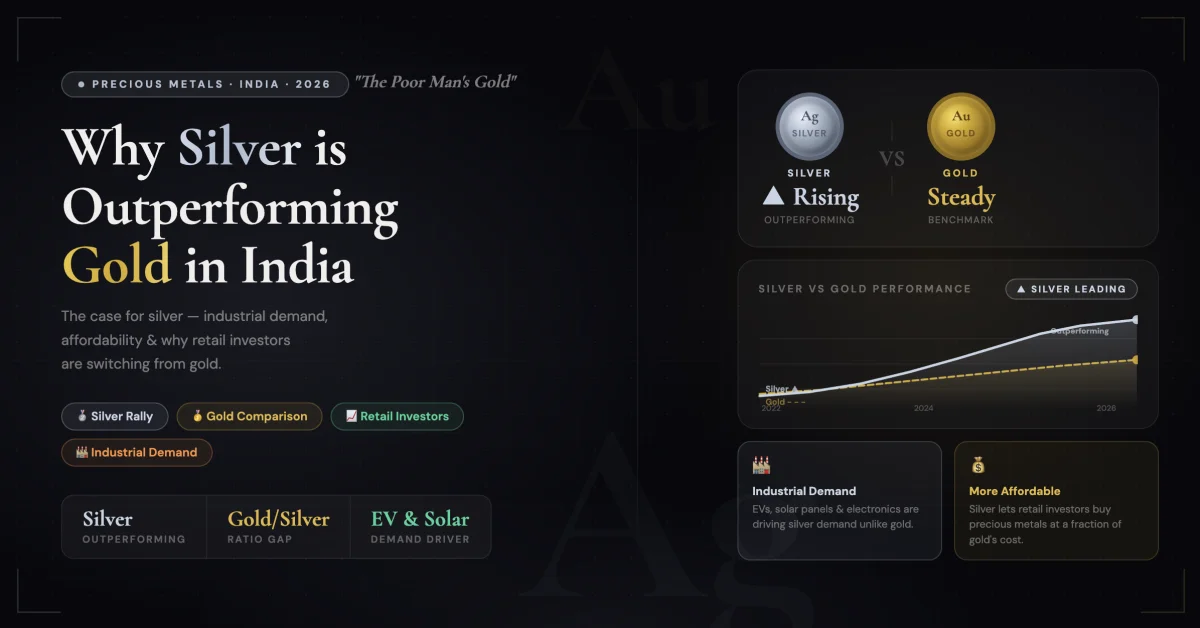
In the last 24 months, silver has outperformed gold on a percentage return basis — driven by a unique combination of investment demand, industrial consumption, and a global supply deficit that gold simply does not have.
This article explains exactly why silver deserves a place in every Indian retail investor's portfolio in 2026 — the silver rate today, how to buy silver without touching physical metal, the best silver ETFs in India, and a complete gold vs silver comparison with real numbers.
Silver Rate Today in India — Where It Stands and Why It Moved
The silver rate today in India is determined by three factors working together:
1. International spot price of silver
(in USD per troy ounce):
Silver is a globally traded commodity.
The international price is set on the
COMEX exchange in New York and the
London Bullion Market (LBMA).
As of March 2026, silver is trading
around $33–$35 per troy ounce globally
— up significantly from $24–$26 in early 2024.
2. USD/INR exchange rate:
Since silver is priced in dollars internationally,
a weaker rupee makes silver more expensive
in India even if the dollar price stays flat.
At USD/INR of approximately ₹84–₹86,
the rupee impact adds meaningful
premium to domestic silver prices.
3. Import duty and GST:
India levies 10% customs duty + 3% GST
on silver imports — adding approximately
13% to the landed cost of silver in India
compared to international prices.
Current silver rate in India (approximate, March 2026):
- Silver per 10 grams: approximately ₹1,050–₹1,100
- Silver per 100 grams: approximately ₹10,500–₹11,000
- Silver per 1 kg: approximately ₹1,05,000–₹1,10,000
⚠️ Important: Silver rates change daily and vary slightly between cities due to local taxes and transportation costs. For the exact live silver rate today, check the MCX (Multi Commodity Exchange) website — mcxindia.com — or any major jeweller's website for their current buying/selling rate.
Silver rate trend — 5 year context:
- March 2020 (COVID crash): ~₹37,000 per kg
- August 2020 (post-COVID rally): ~₹80,000 per kg — a 116% gain in 5 months
- 2021–2023: Rangebound ₹55,000–₹75,000
- 2024–2025: Breakout — crossed ₹90,000 per kg
- 2026 (current): ₹1,00,000–₹1,10,000 per kg — new all-time highs in rupee terms
Anyone who invested in silver at any point in 2020–2021 is sitting on 40–180% returns in rupee terms depending on their entry point.
Why Silver Is Outperforming Gold — The Real Reasons
Silver is often called the "poor man's gold" — implying it's a cheaper, inferior substitute. This framing misses something important: silver has a dual demand structure that gold does not.
Reason 1 — Industrial Demand Is Exploding and Cannot Be Substituted
Gold is primarily a monetary and jewellery metal. Approximately 90% of gold demand is investment, central bank buying, and jewellery.
Silver is different. Approximately 50–55% of silver demand is industrial — and the industries driving that demand are among the fastest-growing in the world:
- Solar panels: Every solar panel requires silver for its conductive paste — approximately 20 grams of silver per panel on average. Global solar capacity is being installed at record pace — India alone is targeting 500 GW of solar by 2030. Each GW of solar capacity requires approximately 70–80 tonnes of silver.
- Electric vehicles (EVs): Each EV uses 25–50 grams of silver in electrical contacts, sensors, and battery management systems — significantly more than a conventional vehicle. Global EV sales are growing 25–30% annually.
- 5G infrastructure: Silver is used in circuit boards, connectors, and antennas in 5G equipment. India's 5G rollout is still less than 30% complete as of 2026 — years of silver-intensive buildout remain.
- Medical devices: Silver's antimicrobial properties make it indispensable in wound dressings, coatings, and devices.
The critical point: industrial silver is consumed — it cannot be easily recycled back into investment-grade silver. When a solar panel degrades and is scrapped, the silver in it is largely lost. This structural consumption creates a demand floor that gold simply doesn't have.
Reason 2 — The Gold-to-Silver Ratio Is Historically Stretched
The gold-to-silver ratio measures how many ounces of silver it takes to buy one ounce of gold. Historically, this ratio has averaged 50–60x over the long term.
As of 2026, the ratio is approximately 85–90x — meaning silver is historically cheap relative to gold.
Every time this ratio has reached extreme levels and then reverted to its mean, silver has significantly outperformed gold during the correction:
- 2011: Ratio compressed from 80x to 32x — silver gained 175% while gold gained 50%
- 2020: Post-COVID, ratio went from 125x to 65x — silver gained 140% while gold gained 25%
A reversion to the historical 50–60x ratio from today's 85–90x would imply silver needing to outperform gold by 40–80% just to reach historical norms.
Reason 3 — Global Supply Deficit
The Silver Institute (a global industry body) has reported a structural supply deficit in silver for 3 consecutive years — meaning the world is consuming more silver than it is mining annually.
This is unusual. For most of the last 50 years, silver had a supply surplus — mines produced more than was needed. The explosion in solar and EV demand has permanently shifted this equation.
A sustained supply deficit, combined with growing investment demand and currency debasement concerns globally, creates a structural tailwind that gold shares only partially.
Gold vs Silver — Complete Comparison for Indian Investors
The question is not which is better. Both serve different purposes. The question is: what role does each play in a balanced Indian retail portfolio?
Gold — What it does well:
- Pure crisis hedge — when war, inflation, and uncertainty spike, gold is the most reliable safe-haven asset
- Central bank buying — global central banks have been net buyers of gold for 10+ years, providing a structural demand floor
- Liquidity — gold is the most liquid commodity in the world, buyable and sellable anywhere
- Lower volatility — gold moves more predictably than silver
Silver — What it does well:
- Higher return potential — silver historically outperforms gold during bull markets in precious metals
- Industrial demand floor — solar, EVs, 5G create real consumption-driven demand
- Lower entry price — silver is approximately 85x cheaper than gold per unit weight, making it accessible to every income level
- Supply deficit — structural undersupply creates a medium-term price catalyst
Silver's weakness:
- Higher volatility — silver can fall 30–40% during risk-off periods when gold falls only 10–15%
- Less liquid than gold in physical form in smaller cities
- Industrial demand can weaken during global recessions — gold holds better during economic downturns
Gold vs Silver ETF — Which Is Better for a Retail Investor in India?
For an Indian retail investor deciding between a Gold ETF and a Silver ETF:
If your goal is capital preservation and crisis hedging: Gold ETF. More stable, central bank backed, globally trusted in every economic scenario.
If your goal is return maximisation over a 5–10 year horizon: Silver ETF — especially given the current gold-silver ratio and the structural demand from the green energy transition.
Best allocation for most retail investors: Hold both. A 70% gold / 30% silver split within your precious metals allocation gives you the stability of gold with the growth potential of silver. Or if you have nothing currently, start with silver first — given the current valuation relative to gold.
Silver ETF India — Complete Guide 2026
The most practical way for an Indian retail investor to buy silver in 2026 is through a Silver ETF — a stock exchange-listed fund that tracks the price of physical silver without you needing to store, insure, or handle any metal.
What Is Silver BeES / Silver ETF?
A Silver ETF (Exchange Traded Fund) holds physical silver in a SEBI-regulated vault and issues units on the stock exchange. When you buy one unit of a Silver ETF, you own a proportional claim on physical silver stored in a bank vault.
Silver BeES share price — you'll often see this term in searches. BeES stands for Benchmark Exchange Traded Scheme — it refers to ETFs modelled after the original Nippon (formerly Benchmark) ETF structure. The silver equivalent is the Nippon India Silver ETF, whose share price moves in direct proportion to silver prices.
Best Silver ETFs in India 2026
HDFC Silver ETF
Expense ratio: 0.54% per annum
Underlying:
Physical silver stored in HDFC Bank vaults
Minimum purchase: 1 unit (≈₹100–₹110)
HDFC Silver ETF share price:
Check live on NSE website or
your Zerodha/Groww app under ticker SILVERETF
✅ Best for: HDFC banking relationship holders,
most liquid among silver ETFs
SBI Silver ETF
Expense ratio: 0.45% per annum
Underlying: Physical silver,
SBI Funds Management
Minimum purchase: 1 unit
✅ Best for: SBI account holders,
slightly lower expense ratio than HDFC
Nippon India Silver ETF
Expense ratio: 0.40% per annum
Nippon Silver ETF share price:
Tracks MCX silver price closely
✅ Best for: Investors who already
use Nippon India mutual funds
Axis Silver ETF
Expense ratio: 0.50% per annum
Axis Silver ETF share price:
Available on NSE under AXSILVER
✅ Best for: Axis Bank customers
Key point — all silver ETFs track the same underlying price. The difference is expense ratio (lower is better) and liquidity (higher average daily volume = easier to buy and sell without price impact). HDFC and Nippon have the highest trading volumes currently.
How to Buy Silver ETF in India — Step by Step
- Open a demat account if you don't have one — Zerodha, Groww, or Upstox (takes 15–30 minutes online)
- Complete KYC — Aadhaar + PAN + bank account verification
- Search for your chosen Silver ETF by its ticker symbol — SILVERETF (HDFC), SILVERBEES (Nippon), AXSILVER (Axis)
- Enter quantity — 1 unit = approximately ₹100–₹110 at current prices. Buy as many units as your budget allows.
- Place a market order (during market hours 9:15 AM – 3:30 PM) or a limit order at your preferred price
- Units credited to your demat account — you now own physical silver stored in a SEBI-regulated vault
Digital Silver — Buy Silver Online Without a Demat Account
How to Buy Digital Silver Online in India
If you don't have a demat account and want to start buying silver with as little as ₹1 — digital silver is the entry point.
What is digital silver: You purchase silver digitally through apps like PhonePe, Google Pay, Paytm, or dedicated platforms like SafeGold and MMTC-PAMP. Your purchase is backed by actual physical silver stored in a secured vault — you can take physical delivery later if you want.
Best platforms to buy digital silver online:
MMTC-PAMP Digital Silver:
India's most reputable source
for digital silver.
MMTC-PAMP is a joint venture between
the Government of India's MMTC
and Switzerland's PAMP SA —
the world's leading precious metals refinery.
Available on PhonePe,
Paytm, and mmtcpamp.com directly.
Minimum: ₹1
Purity: 999 fine silver
Delivery: Yes —
you can request physical delivery
of coins or bars
SafeGold Digital Silver:
Available on Google Pay and
many banking apps.
Physical silver stored in
Brinks (world's largest security company) vaults.
Minimum: ₹10
Buy Silver Coins and Silver Bars Online:
For larger amounts (above ₹5,000),
buying physical silver coins or bars
from reputable dealers makes sense:
- MMTC-PAMP (mmtcpamp.com) — 100g and 1kg bars, certifiable purity, delivered to your door
- Muthoot Silver — coins and small bars, available in branches across India
- Augmont (augmont.in) — online silver coin and bar delivery, transparent pricing
⚠️ Digital silver vs Silver ETF —
which is better?
Digital silver (PhonePe, Paytm) —
easiest to start, no demat needed,
but NOT regulated by SEBI.
The platform operator bears counterparty risk.
Best for amounts under ₹25,000.
Silver ETF —
SEBI-regulated, demat-based,
more secure for larger holdings.
Best for amounts above ₹25,000
and for systematic long-term investing.
How to Invest in Silver India — The Complete Strategy for Every Budget
Budget under ₹1,000/month:
→ Buy digital silver on PhonePe or Paytm —
₹500–₹1,000/month accumulated
→ Once you reach ₹5,000 in digital silver,
convert to physical coins via MMTC-PAMP delivery
→ Simultaneously open a demat account
to graduate to Silver ETF
Budget ₹1,000–₹5,000/month:
→ Open demat account on Groww or Zerodha
→ Buy 10–50 units of HDFC or Nippon Silver ETF monthly
→ Set a reminder (not auto-SIP —
ETFs require manual purchase)
on the 5th of every month after salary credit
→ Track on RozHisab as a separate investment category
Budget ₹5,000–₹20,000/month:
→ Split:
70% Silver ETF + 30% physical coins
→ Every 6 months, evaluate gold-silver ratio —
if ratio exceeds 90x,
increase silver allocation
→ Consider Silver Fund of Fund
(available from ICICI Prudential)
if you want mutual fund SIP structure
without needing to manually buy ETF units
Return on Silver Investment — What the Data Actually Shows
Silver returns in India — key historical periods:
- 10-year return (2015–2025): approximately +185% in rupee terms
- 5-year return (2020–2025): approximately +120% in rupee terms (from COVID lows)
- 1-year return (2024–2025): approximately +28–35% — outperforming Nifty 50 in the same period
For comparison — Gold returns in same periods:
- 10-year: approximately +175%
- 5-year: approximately +85%
- 1-year: approximately +20–25%
Silver has outperformed gold across all three timeframes in rupee terms — despite being conventionally described as the "lesser" precious metal.
White gold vs silver vs platinum
— investment returns comparison:
White gold is not an investment asset —
it is jewellery.
Platinum, while a precious metal,
has dramatically underperformed
both gold and silver over the last decade
due to weak automotive catalyst demand
and competition from palladium.
For pure investment purposes,
silver has the strongest
risk-adjusted return case
among the three in 2026.
The Risk You Must Understand Before Investing in Silver
Silver is not a safe, boring asset. Before allocating to it, understand these real risks:
Volatility: Silver can fall 30–40% in a bear market for precious metals. In 2022, silver fell from $26/oz to $17/oz — a 35% decline — in less than 6 months. Anyone who panic-sold lost real money.
Industrial demand cyclicality: In a global recession, industrial demand for silver (solar, EVs, electronics) slows down — which can temporarily overwhelm the investment demand narrative.
Storage and insurance cost for physical: Physical silver bars and coins require secure storage. Unlike digital silver or Silver ETF, physical silver held at home needs insurance — adding 0.5–1% of value annually in cost.
GST on physical silver: Physical silver purchases attract 3% GST. Silver ETFs attract capital gains tax (20% LTCG if held over 3 years) but no GST — making ETFs more tax-efficient than physical for pure investment purposes.
The correct mindset: Silver is a 5–10 year position, not a 6-month trade. The structural demand story (solar, EVs, supply deficit) plays out over years, not months. Investors who hold through the inevitable volatility are the ones who capture the full return.
Track Your Silver Investment Alongside Your Complete Portfolio
Most Indian investors who buy Silver ETF or digital silver have no idea what their total precious metals allocation looks like relative to their equity and debt portfolio.
They buy gold ETF on Zerodha, digital silver on PhonePe, mutual funds on Groww, and FD on SBI — and have no single place that shows their complete portfolio in one view.
This fragmentation causes two problems:
- They over-allocate to precious metals without realising it — sometimes 30–40% of net worth in gold and silver when 10–15% is the recommended maximum
- They can't track their actual returns on silver vs their other assets — so they don't know whether the silver bet is actually working
Use RozHisab to log every silver ETF purchase, digital silver accumulation, and physical coin purchase alongside your equity SIPs, FDs, and monthly expenses. See your complete asset allocation and actual return on silver investment in one free dashboard — built specifically for Indian households managing money across multiple platforms and instruments.
Because the investors who build wealth from silver are not the ones who bought at the perfect time. They are the ones who stayed invested, tracked their position honestly, and held through the volatility long enough for the structural demand story to play out.
👉 Start tracking your silver and complete investment portfolio for free at RozHisab — because knowing your exact allocation is the first step to optimising it.
Quick Reference — Silver Investment Guide for Indian Retail Investors
- 🥈 Silver rate today: Check MCX (mcxindia.com) for live price — approximately ₹1,05,000–₹1,10,000/kg as of March 2026
- 📈 Best silver ETF India: HDFC Silver ETF or Nippon Silver ETF (highest liquidity, lowest tracking error)
- 📱 Best digital silver platform: MMTC-PAMP via PhonePe (government-backed, highest purity, delivery option)
- 🏦 Best for beginners: Digital silver on PhonePe — start with ₹100, upgrade to ETF after ₹5,000 accumulated
- ⚖️ Gold vs silver today: Ratio at 85–90x — historically stretched, favours silver for new allocation
- 📊 Return on silver investment: +185% over 10 years in INR — outperforming gold in same period
- ⚠️ Key risk: 30–40% drawdown possible during risk-off periods — hold only what you can stay invested in for 5+ years
- 💡 Recommended allocation: 5–15% of total investment portfolio — split 70% gold / 30% silver within precious metals bucket
- 📱 Track it all: Log every purchase on RozHisab — see your total precious metals allocation vs equity and debt in real time
Track your own finances — free forever
Use RozHisab to apply everything in this article to your actual spending and savings.
Start Tracking Free →