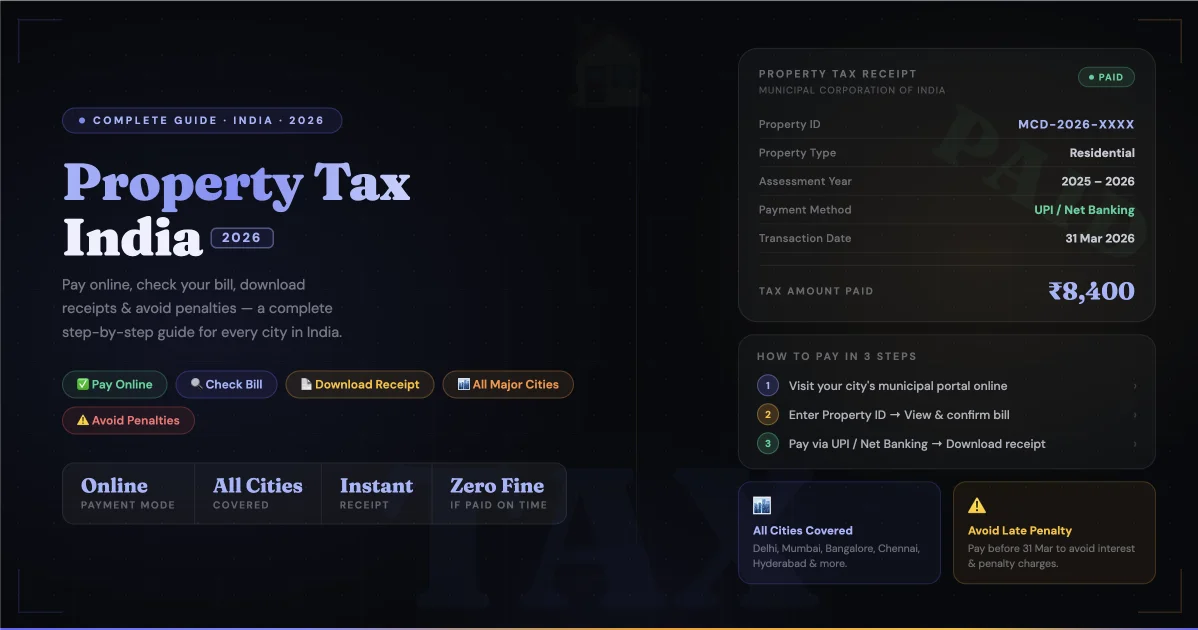
Property Tax India 2026 — How to Pay Online, Check Bills, Download Receipts (BBMP, GHMC, MCD, Chennai, Pune)
ℹ️ Disclaimer: This article is for general educational and informational purposes only. Property tax rates, deadlines, portals, and calculation methods vary by city and change periodically. Always verify current rates and deadlines on your municipal corporation's official website before making any payment. Nothing in this article constitutes legal or financial advice. RozHisab is a personal finance tracking tool — not a tax advisory service.
If you own a house, flat, shop, or any property in India — you owe property tax to your local municipal corporation every year.
Most property owners know this. What most don't know is:
- Exactly how much they owe and why
- Where to pay it online in under 5 minutes
- What happens if they don't pay on time
- How to download their receipt as proof
- The capital gains tax implications when they eventually sell the property
This guide covers all of it — city by city, step by step, in plain language.
What Is Property Tax in India — And Who Must Pay It
Property tax (also called house tax in common usage) is an annual tax levied by your local municipal corporation on immovable property — residential homes, commercial buildings, vacant land, and rental properties.
It is one of the primary revenue sources for municipal bodies — the money funds local infrastructure: roads, drainage, street lighting, garbage collection, and parks in your area.
Who must pay property tax in India:
- Anyone who owns residential property — independent house, flat, apartment
- Commercial property owners — shops, offices, warehouses
- Owners of vacant plots in municipal limits (in most cities)
- Landlords who rent out property (the owner pays tax, not the tenant — unless the rental agreement specifically transfers this liability)
Who is typically exempt:
- Properties used exclusively for religious purposes
- Properties owned by ex-servicemen (partial or full exemption in many states)
- Senior citizens (partial rebate in some municipal corporations)
- Properties below a specified area threshold (varies by city)
How Property Tax Is Calculated in India
Property tax is not a flat rate. It is calculated based on a formula that varies by city — but most municipal corporations use one of two systems:
System 1 — Annual Rental Value (ARV) Method
Used by: Chennai, Hyderabad (GHMC), Kolkata (KMC), and older municipal bodies.
Formula:
Property Tax = Annual Rental Value
× Tax Rate (as percentage)
Annual Rental Value is the estimated annual rent the property could earn — set by the municipal corporation based on area, location, and property type. It is not your actual rent.
Example:
ARV set by corporation: ₹60,000/year
Tax rate: 15%
Annual property tax: ₹9,000
System 2 — Unit Area Value (UAV) Method
Used by: Delhi (MCD), Bangalore (BBMP), Pune (PCMC), and most modern municipal corporations.
Formula:
Property Tax =
Unit Area Value × Built-up Area
× Age Factor × Use Factor
× Structure Factor × Occupancy Factor
Each factor is defined by the municipal corporation:
- Unit Area Value: Per sq ft value assigned to your area/zone (higher for prime localities)
- Built-up area: Total covered area of your property in sq ft
- Age factor: Older buildings get a rebate (property tax decreases with age)
- Use factor: Residential vs commercial vs industrial (commercial pays more)
- Occupancy factor: Self-occupied vs rented (rented properties often pay higher tax)
Each municipal corporation publishes its specific rates and factors on its official portal — or you can use the online property tax calculator available on most city portals (covered in each city section below).
Online Property Tax Payment — Complete City-by-City Guide 2026
🔵 BBMP Property Tax — Bangalore
Authority:
Bruhat Bengaluru Mahanagara Palike (BBMP)
Official portal:
bbmptax.karnataka.gov.in
Payment deadline:
April 30 each year (for full year)
— late payment attracts 2% penalty per month
BBMP property tax online payment — step by step:
- Go to bbmptax.karnataka.gov.in
- Click "Property Tax Payment" on the homepage
- Enter your Application Number (SAS ID) — found on your previous year's tax receipt or property documents
- If you don't have the SAS ID, use "Search by Owner Name" or "Search by Site Number"
- Your property details and tax amount due will appear
- Verify the details — built-up area, zone, usage type
- Click "Pay Online" → choose payment method: Debit Card / Credit Card / Net Banking / UPI
- Complete payment → download receipt immediately
BBMP property tax receipt download:
After payment → go to the same portal →
"Download Receipt" →
enter your Application Number →
download PDF. Save this PDF —
it is required for property sale,
home loan documentation, and Khata transfer.
BBMP tax calculation tip: Bangalore uses the Self Assessment Scheme (SAS). You self-declare your property details and calculate tax using the BBMP calculator. If your property has had any construction additions since last assessment, declare them accurately — underdeclaration attracts penalties.
⬆️ Rising query alert: `bbmp tax` is growing at +20% in Google Trends India — one of the fastest-rising property tax queries nationally. If you live in Bangalore and haven't paid for FY 2025-26, the deadline is approaching.
🔴 GHMC Property Tax — Hyderabad / Telangana
Authority:
Greater Hyderabad Municipal Corporation (GHMC)
Official portal:
ghmc.gov.in/propertytax
Also covers:
Secunderabad, Cyberabad, and
Hyderabad Metropolitan area
GHMC property tax online payment — step by step:
- Go to ptgis.ghmc.gov.in
- Click "Property Tax"
- Enter PTIN (Property Tax Identification Number) — on your previous receipt or property documents
- Alternatively, search by owner name or door number
- Current dues will appear — verify the assessment details
- Click "Pay Online" → choose UPI / Net Banking / Card
- Download GHMC property tax receipt immediately after payment
GHMC property tax receipt download:
ptgis.ghmc.gov.in →
Payment History →
enter PTIN →
download receipt for any year.
Telangana property tax — other areas: For properties outside GHMC limits (smaller towns in Telangana), use the CDMA portal: cdma.telangana.gov.in — this covers all urban local bodies in Telangana outside GHMC.
GHMC property tax dues check: To check if you have any outstanding dues from previous years, go to ptgis.ghmc.gov.in → "Dues" tab → enter PTIN. Pay all dues including penalty before the current year payment is accepted in full.
🟠 MCD Property Tax — Delhi
Authority:
Municipal Corporation of Delhi (MCD)
Official portal:
mcdonline.nic.in
Coverage:
All of Delhi — North, South,
and East Delhi (now unified under one MCD)
MCD property tax online payment — step by step:
- Go to mcdonline.nic.in
- Click "Property Tax" in the top navigation
- Select "Pay Property Tax"
- Enter Property ID (12-digit number on old receipts) or Colony + Owner Name
- Property and dues details appear
- Select the financial year to pay
- Click "Proceed to Pay" → choose payment mode
- Download MCD property tax receipt
Delhi property tax — Unit Area System: Delhi uses the Unit Area Value system. Properties are categorised into 8 categories (A to H) based on colony type — A being the most premium (e.g., Defence Colony, Vasant Vihar) and H being the lowest (unauthorised/regularised colonies).
Delhi property tax key rates 2026:
- Residential self-occupied: 11% of Annual Value
- Residential rented out: 15% of Annual Value
- Commercial properties: 20% of Annual Value
Important — Delhi property tax rebate: MCD offers a 15% rebate for women as sole owners and a 30% rebate for senior citizens on self-occupied residential properties. Claim these at the time of online payment by selecting the appropriate rebate category.
🟡 Chennai Property Tax — Greater Chennai Corporation
Authority:
Greater Chennai Corporation (GCC)
Official portal:
chennaicorporation.gov.in
Also known as:
Chennai Corporation, Corporation of Chennai
Chennai property tax online payment — step by step:
- Go to chennaicorporation.gov.in
- Click "Online Services" → "Property Tax"
- Enter your Zone, Division, and Assessment Number (on previous receipt)
- Or search by owner name and street address
- Dues appear — verify details
- Pay via Net Banking / UPI / Card
- Download receipt immediately
Chennai property tax — half-yearly payment: Unlike most cities where property tax is annual, Chennai Corporation collects tax half-yearly — April and October. Deadlines: April 30 and October 31 each year. Missing either deadline attracts penalty.
Corporation of Chennai property tax status: To check payment status or outstanding dues: chennaicorporation.gov.in → Property Tax → Check Status → enter Assessment Number.
🟢 PCMC Property Tax — Pune (Pimpri-Chinchwad)
Authority:
Pimpri Chinchwad Municipal Corporation (PCMC)
Official portal:
pcmcpune.gov.in
Coverage:
Pimpri, Chinchwad, Akurdi,
Nigdi, Bhosari, and surrounding areas
Note: For Pune city
(PMC area — Shivajinagar, Kothrud, Hadapsar),
the portal is pmc.gov.in
PCMC property tax online payment — step by step:
- Go to pcmcpune.gov.in
- Click "Property Tax"
- Enter your Property Number (on old receipts or property index)
- Current year dues appear
- Verify — owner name, plot area, use type
- Pay online via UPI / Card / Net Banking
- Download PCMC property tax bill and receipt
PCMC property tax bill download: pcmcpune.gov.in → Property Tax → Download Bill → enter Property Number → select year → download PDF.
⬆️ Rising query alert: `pcmc property tax` is growing at +20% in Google Trends — one of the fastest-rising property tax queries nationally, reflecting Pune's rapid residential development and growing urban population.
🔵 KMC Property Tax — Kolkata
Authority:
Kolkata Municipal Corporation (KMC)
Official portal:
kmcgov.in
KMC property tax online payment:
- Go to kmcgov.in
- Click "Property Tax"
- Enter Assessee Number
- Dues appear → pay via Net Banking / Card / UPI
- Download receipt
KMC uses the Annual Rental Value method — older system but well-established. Kolkata has one of the more complex property tax systems due to the city's mix of very old and new properties with different valuation bases.
Other Cities — Quick Reference Portals
- 🏙️ Haryana (all cities): ulbhryndc.org — covers Gurugram, Faridabad, Ambala, Hisar
- 🏙️ Bhopal (MP): bhopal.samagra.gov.in
- 🏙️ Coimbatore: ccmc.gov.in
- 🏙️ RMC (Rajkot): rmcrajkot.org
- 🏙️ MCGM (Mumbai): mcgm.gov.in — note: Mumbai uses a different system called Property Tax based on Rateable Value (RV)
- 🏙️ AP (Andhra Pradesh): cdma.ap.gov.in — covers all AP urban local bodies
- 🏙️ NKDA (New Town, Kolkata): nkdamar.in
Property Tax Receipt Download — Why It Matters Beyond Just Proof of Payment
Most property owners download the receipt, save it on their phone, and forget about it. Here is why your property tax receipt is more important than you think:
- Property sale: Buyers (and their lawyers) verify that property tax is paid up to date. Outstanding dues can block or delay property registration.
- Home loan: Banks ask for the last 2–3 years' property tax receipts as part of home loan documentation.
- Khata/mutation transfer: Adding your name to municipal records after purchasing a property requires the previous owner's tax clearance.
- Income tax — HRA and 24B: Property tax paid is deductible from rental income under Section 24 of the Income Tax Act when computing taxable rental income.
- Legal disputes: Property tax receipts in your name constitute evidence of continuous possession and ownership.
Best practice: Download your receipt every year immediately after payment. Save it in a dedicated folder named "Property Documents" on Google Drive — accessible anywhere, never lost even if you change phones.
Capital Gain Tax on Sale of Property — What Property Owners Must Know
⚠️ Tax laws change. Consult a chartered accountant or tax professional for advice specific to your situation. The information below is general and educational in nature.
When you sell a property in India, the profit you make is subject to Capital Gains Tax — one of the most significant tax liabilities most Indians face and one of the least understood.
Short Term vs Long Term Capital Gains on Property
Holding period determines the category:
- Held for 24 months or less: Short Term Capital Gain (STCG) — taxed at your applicable income tax slab rate (can be 5%, 20%, or 30% depending on your total income)
- Held for more than 24 months: Long Term Capital Gain (LTCG) — taxed at 12.5% without indexation (as per Budget 2024 changes effective from July 23, 2024)
Important Budget 2024 change: Before July 23, 2024, LTCG on property was taxed at 20% with indexation benefit (which adjusts the purchase price for inflation, reducing the taxable gain). After July 23, 2024, the rate changed to 12.5% without indexation. For properties purchased before this date and sold after, taxpayers may have the option to choose between the old and new regime — consult a CA for your specific situation.
How Capital Gain on Property Is Calculated
Basic formula:
Capital Gain = Sale Price −
(Purchase Price + Cost of Improvement
+ Cost of Transfer)
Costs that reduce your capital gain:
- Original purchase price
- Stamp duty and registration paid at purchase
- Brokerage paid on purchase
- Cost of any major renovation or addition (with receipts/bills)
- Brokerage paid on sale
Example (illustrative only):
Purchased flat in 2018 for ₹50 lakh
Stamp duty + registration: ₹3 lakh
Renovation: ₹2 lakh
Total cost base: ₹55 lakh
Sale price in 2026: ₹85 lakh
Capital Gain: ₹85L − ₹55L = ₹30 lakh
LTCG tax at 12.5%: ₹3.75 lakh
How to Save Capital Gains Tax on Property — Legal Exemptions
Section 54 — Reinvest in another house: If you sell a residential property and reinvest the capital gain in another residential property within 2 years (purchase) or 3 years (construction), the capital gain is exempt from tax. The new property must be in India. This is the most commonly used LTCG exemption for property sellers.
Section 54EC — Invest in specified bonds: Invest the capital gain in specified government bonds (NHAI, REC) within 6 months of property sale — exempt up to ₹50 lakh. Lock-in: 5 years.
Section 54F — For non-residential property: Selling a commercial property or plot? Invest the entire sale proceeds (not just the gain) in a residential property → full capital gain exemption (proportional if partial reinvestment).
⚠️ Again — these are general summaries. Tax laws have nuances, conditions, and exceptions. Engage a chartered accountant before making decisions based on capital gains exemptions.
Property Tax and Your Monthly Budget — The Planning Gap Most Owners Ignore
Property tax is an annual payment — but it affects your monthly budget throughout the year.
A property tax bill of ₹12,000 annually is ₹1,000 per month of budget impact — even if you pay it all in April. Most property owners don't provision for it. Then April arrives, the bill comes, and ₹12,000 leaves the account in one shot — disrupting that month's budget significantly.
The solution is simple: treat property tax as a monthly expense of ₹1,000 (or whatever your annual amount divided by 12 is) in your monthly budget, even though the actual payment is annual or half-yearly. Set aside that amount every month in a separate savings account or liquid fund — so when the bill arrives, the money is already there.
Use RozHisab to track your property tax as a recurring annual expense in your financial dashboard — alongside your monthly rent/EMI, insurance premiums, and other big annual payments. When all your large irregular expenses are visible in one place, you can plan for them in advance rather than scrambling when the bill arrives.
Track property tax paid, capital gains from property sale, rental income from property, and all related expenses — home loan EMI, maintenance charges, society fees — in one unified income-expense dashboard. See your complete property-related financial picture clearly.
Quick Reference — Property Tax India 2026 Cheatsheet
- 🔵 Bangalore (BBMP): bbmptax.karnataka.gov.in — deadline April 30 — use SAS ID
- 🔴 Hyderabad (GHMC): ptgis.ghmc.gov.in — use PTIN number
- 🟠 Delhi (MCD): mcdonline.nic.in — use Property ID — rebate for women and senior citizens
- 🟡 Chennai (GCC): chennaicorporation.gov.in — half-yearly payment (April 30 + October 31)
- 🟢 Pune/PCMC: pcmcpune.gov.in — use Property Number
- 🔵 Kolkata (KMC): kmcgov.in — use Assessee Number
- 📄 Receipt download: Always download immediately after payment — needed for property sale, home loan, ITR
- 💰 LTCG on property sale: 12.5% (held 24+ months) — save via Section 54 reinvestment
- 📊 Budget for property tax: Divide annual bill by 12 — set aside monthly on RozHisab
📌 Disclaimer: This article is for educational and informational purposes only. Property tax rates, portals, deadlines, and capital gains tax rules change periodically and vary by city and state. Always verify on your municipal corporation's official website and consult a qualified tax professional before making financial or legal decisions related to property. RozHisab is a budgeting and expense tracking tool — not a tax or legal advisory service.
Track your own finances — free forever
Use RozHisab to apply everything in this article to your actual spending and savings.
Start Tracking Free →