Petrol Diesel Price Today — How the Israel-Iran War Is Triggering a Global Economic Slowdown and What It Means for India — RozHisab
← Blog
Personal Finance

Petrol Diesel Price Today — How the Israel-Iran War Is Triggering a Global Economic Slowdown and What It Means for India
✍️ Yash 📅 22 Mar 2026 ⏱ 13 min read
Petrol Diesel Price Today — How the Israel-Iran War Is Triggering a Global Economic Slowdown and What It Means for India

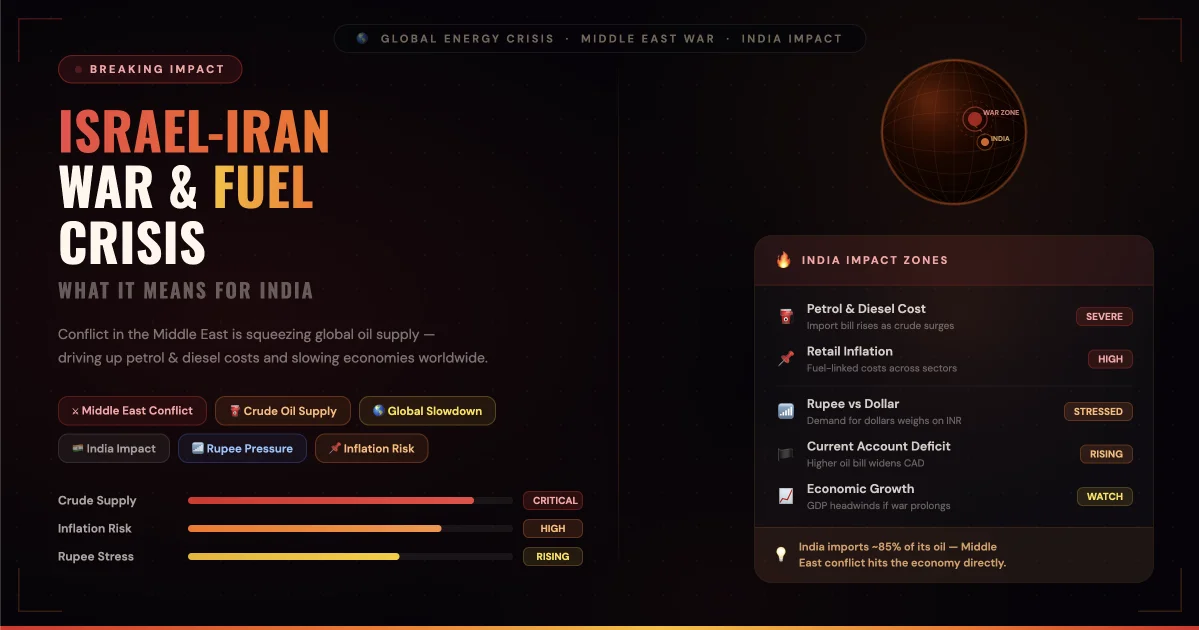
Three things are happening simultaneously in 2026 that haven't happened together since the 1970s oil crisis: A major Middle East war between two significant oil-producing and oil-transit nations — Israel and Iran. A global economic slowdown triggered by US tariffs, rising interest rates, and post-pandemic demand collapse. A recession scare in the United States — the world's largest economy and India's biggest export market. Each of these alone would be significant. Together, they are creating one of the most complex economic environments India has faced in decades. And the most visible sign of this complexity for ordinary Indians is simple and immediate: petrol and diesel prices are under enormous pressure to rise — and the ripple effects go far beyond the fuel pump. This article explains the full chain — from Iran's oil fields to your monthly household budget — and what you can actually do about it.

The Israel-Iran War — Why It Directly Controls Petrol Prices in India

India imports 85% of its crude oil. That crude largely travels through or near the Middle East. When that region goes to war, India's fuel economy is directly in the line of fire — not militarily, but economically. Here is the exact mechanism: Iran sits on the world's fourth-largest proven oil reserves and produces roughly 3.5 million barrels of crude per day. More critically, Iran controls access to the Strait of Hormuz — the narrow waterway through which approximately 20% of all global oil trade passes every single day. That includes oil from Saudi Arabia, UAE, Kuwait, Iraq, and Qatar — all of which supply India heavily. 
When Israel and Iran exchange attacks — missiles, drones, airstrikes — global oil traders immediately price in the risk of Hormuz disruption. Even if the strait isn't physically blocked, the fear alone is enough to push Brent crude from $80 to $90 or $100 per barrel within days. For India, every $10 rise in crude costs the country approximately ₹15,000 crore more per year in import bills. That cost doesn't disappear. It either gets passed to you at the petrol pump and LPG cylinder — or it gets absorbed by the government at the cost of a widening fiscal deficit, which creates inflation through a different route. Either way, you pay.

Petrol and Diesel Price Today — Where We Are and Where We're Heading

As of March 2026, petrol and diesel prices across major Indian cities:
Delhi: Petrol ₹94.77/litre | Diesel ₹87.67/litre
Mumbai: Petrol ₹103.44/litre | Diesel ₹89.97/litre  
Bangalore: Petrol ₹102.86/litre | Diesel ₹88.94/litre
Chennai: Petrol ₹100.75/litre | Diesel ₹92.34/litre
These prices have been held artificially stable by the government through election cycles and subsidy decisions. The underneath number — the actual cost at which oil marketing companies are procuring and refining crude — is rising. India's three major oil marketing companies — HPCL, BPCL, and IOC — are the ones who actually set retail fuel prices (with government approval). When crude stays elevated for more than a few weeks, the pressure to revise prices upward becomes unavoidable. If Brent crude crosses $95–$100 per barrel and stays there for 30+ days, expect a petrol and diesel price revision of ₹5–₹10 per litre across India. That would push petrol above ₹105 in Delhi and above ₹115 in Mumbai. For a household with one car filling 40 litres twice a month, that's ₹800–₹1,600 in additional annual fuel expenses — before accounting for the inflation it triggers everywhere else.

India's Oil Refineries — Why We Can't Just Produce Our Own Fuel

India does have oil refineries. In fact, it has some of the largest and most sophisticated in the world.
Major refineries in India:
  1. Jamnagar Refinery (Reliance Industries), Gujarat — The world's largest single-location refinery complex. Processes over 1.24 million barrels per day. Primarily an export refinery — much of its output goes to international markets, not domestic consumption.
  2. Koyali Refinery (IOCL), Gujarat — India's oldest major refinery, processing around 275,000 barrels per day.
  3. Vishakhapatnam Refinery (HPCL), Andhra Pradesh — Major east coast refinery receiving crude from Middle East tankers.
  4. Mangaluru Refinery (MRPL), Karnataka — Key southern India refinery heavily dependent on Middle East crude.
  5. Paradip Refinery (IOCL), Odisha — One of India's newest, largest coastal refineries.
Here's the critical fact that most people don't know: India's refineries are processing machines, not crude producers. They take raw crude oil as input and produce petrol, diesel, aviation fuel, LPG, and other products as output. The crude input is almost entirely imported. So even Reliance's world-class Jamnagar refinery — the most efficient on the planet — is completely exposed to global crude price fluctuations. More Indian refineries do not solve the problem of crude import dependency. That dependency is structural and will take decades to reduce meaningfully.

The Global Economic Slowdown — This Is Bigger Than Just Oil

  1. US Recession Fears — And Why India Should Care Deeply : The United States is showing multiple recession warning signs in 2026: Consumer spending is slowing after years of post-COVID excess. The Federal Reserve's high interest rates (held at 5%+ for over two years) have cooled the housing market, credit card spending, and corporate investment. Tech sector layoffs — which started in 2022 — have continued, denting consumer confidence in America's highest-earning demographic. Why does a US recession matter for India? Three direct channels: IT exports: India's IT sector — TCS, Infosys, Wipro, HCL Tech — earns 60%+ of its revenue from US clients. A US recession means those clients cut IT budgets. That means fewer contracts, slower hiring in India's highest-paying private sector, and lower remittances from Indian professionals in the US. Goods exports: Pharmaceuticals, textiles, engineering goods, and chemicals — India's biggest export categories — all flow heavily to the US market. A recession cuts American consumer and corporate spending on these. FII outflows: When the US economy weakens, global investors pull capital from emerging markets like India back to safe-haven assets. This causes stock market falls, rupee depreciation, and tighter financial conditions in India. India is not decoupled from America. When the US sneezes, India feels it within 6–9 months.
  2. US Tariffs — The Trade War Nobody Is Talking About Enough : In 2025-2026, US tariff policy has become one of the biggest structural risks to India's export economy. The tariff impact on India is complex — some sectors benefit, others are severely hurt: Who loses: Indian exporters of steel, aluminium, electronics, and auto components face higher barriers entering the US market. Pharmaceutical exporters face pressure from US drug pricing reform that reduces the profitability of US-bound generic exports. Who potentially gains: As the US applies heavy tariffs on Chinese goods, some manufacturing shifts away from China. India is positioned to capture some of this — in textiles, electronics assembly, and chemicals. But capturing this opportunity requires infrastructure and policy execution that India is still building. The net effect in the short term: uncertainty. Companies that were planning major US-bound export expansion are pausing. Investment decisions are being delayed. That slowdown in investment is itself a drag on India's GDP growth.
  3. The Broader Global Slowdown — Europe, China, and Commodity Markets : It's not just the US. The global economy is slowing simultaneously across multiple major regions: Europe is stagnating. Germany — Europe's largest economy — has had near-zero GDP growth for two consecutive years. A war-driven energy crisis (Europe is still adjusting to life without Russian gas) is adding to the drag. China is slowing structurally. The property market crisis — with Evergrande and Country Garden collapses — has wiped out trillions in household wealth. Consumer confidence is low. China's demand for global commodities (iron ore, copper, coal) has weakened, which hurts commodity exporters globally including India's raw materials sector. Commodity markets are volatile. War creates price spikes in oil and food (wheat, sunflower oil — both heavily produced in the Israel-Iran conflict zone's broader region). Volatility in commodity prices is itself a drag on global trade — companies can't plan production and supply chains when input costs are unpredictable. India is exposed to all of these simultaneously.

What Economic Impact Did the First World War Have on India? — A Historical Warning

This is not the first time a distant war has economically devastated India. Understanding history is important here. During World War I (1914–1918), India was deeply affected despite being geographically removed from the battlefields: Inflation exploded. The cost of essential goods — food, fuel, cloth — rose 50–100% during the war years. Import supply chains broke down as British shipping was redirected to the war effort. Indian tax burden increased sharply. Britain raised taxes on Indian goods and people to fund the war. India contributed over £146 million to the war effort — paid for by Indian taxpayers and natural resources. Industrial disruption. Indian industries that relied on imported machinery and inputs faced severe supply shortages. The cotton textile industry — India's largest at the time — was particularly hit. The rupee weakened significantly as India's trade balance deteriorated and sterling pressures cascaded into Indian financial markets. The lesson from WWI for 2026 is not about tanks and trenches. It is about supply chain disruption, inflation transmission, currency pressure, and fiscal burden — all of which are happening again, through different mechanisms, right now. Wars don't need to happen in India to economically impact every Indian household.

How This Economic Chain Reaction Hits Your Household Budget

This is where macroeconomics becomes personal. The petrol and diesel price rise is the most visible hit. But it triggers a cascade that most people don't connect: Petrol/diesel rises → transport costs rise across India → Ola, Uber, autos, buses, and goods delivery all become costlier. Diesel powers India's cold chain logistics. Every vegetable, fruit, and dairy product that travels from farm to your local market passes through diesel-powered trucks. A ₹10 rise in diesel translates to ₹5–₹15 per kg increase in grocery costs within 4–6 weeks. Diesel also powers India's irrigation pumps and farm equipment. Higher diesel costs raise food production costs — which again flows into grocery prices. Industrial diesel use rises with fuel costs — manufacturing becomes more expensive — finished goods prices rise. The RBI responds to inflation by raising interest rates — your home loan, car loan, and personal loan EMIs go up. A single crude oil shock from the Middle East — triggered by a war India has no part in — can silently add ₹4,000–₹8,000 to a middle-class urban household's monthly expenses within 6 months. Without a single salary hike to compensate.

What You Can Do Right Now to Protect Your Household from This

You cannot control Brent crude prices, Iran's missiles, or US tariff policy. But you can control how much these external forces affect your personal finances.
  1. Fix Your Fuel Costs Where You Can : Switch to CNG if you drive frequently in a CNG city (Delhi, Mumbai, Pune, Ahmedabad, Surat, Lucknow). CNG currently costs ~₹75/kg versus petrol at ~₹95/litre. Running cost difference: 40–50% lower. Retrofit costs ₹18,000–₹25,000 and pays back in under a year for daily commuters. Switch to PNG for cooking if your area is covered by IGL, MGL, or GAIL city gas distribution — significantly cheaper per unit than LPG and insulated from cylinder-by-cylinder price hikes. Check your LPG subsidy status at mylpg.in — millions of eligible households are missing PAHAL/DBTL subsidies due to broken Aadhaar links.
  2. Build an Inflation Buffer into Your Budget : This is not a 3-month disruption. Geopolitical tensions of this scale typically keep commodity prices elevated for 12–24 months. Revisit your monthly budget with inflation built in: Add ₹500–₹1,000/month to your fuel and transport budget. Add ₹300–₹600/month to your grocery budget. If you have a floating rate home loan, model what your EMI looks like with interest rates 50–100 bps higher. Knowing these numbers in advance removes the emotional shock when the bills arrive.
  3. Protect Your Investments During the Slowdown : Economic slowdowns don't mean stop investing. They mean invest smarter. Shift toward defensive equity sectors — pharma, FMCG, and defence (see our sister article on which sectors to invest in during a market crash). Add gold. Every geopolitical crisis in history has been good for gold. 10–15% allocation to Sovereign Gold Bonds or Gold ETFs is a reasonable hedge right now. Keep 6 months of expenses in liquid funds. Do not invest money you might need in the next 12 months. Increase your SIP amount during market dips — lower NAVs mean more units for the same money. This is rupee cost averaging working exactly as intended.
  4. Track Everything — Especially Now : During a period of rising prices and economic uncertainty, the single most powerful financial tool you have is visibility. Most households during inflationary periods don't realise how much their expenses have risen until 3–4 months in — by which point they've already dipped into savings or accumulated credit card debt. Tracking your actual petrol spend, grocery bills, transport costs, and utility bills in real time lets you make adjustments before the damage compounds. Use RozHisab to log every expense category — fuel, groceries, transport, utilities, and EMIs — and see exactly how inflation is impacting your specific household. When you can see the numbers, you can make decisions. When you can't, you just absorb the damage. Because in an economic slowdown, the households that survive well are not the ones earning the most — they're the ones who know where every rupee is going.

The Bigger Picture — Will This Become a Global Recession?

The honest answer: it depends on how far the Israel-Iran conflict escalates. 
Scenario 1 — Contained conflict (most likely): Iran and Israel exchange limited strikes, neither side escalates to full war, Hormuz remains open, crude settles at $85–$95/barrel. Global slowdown continues but avoids full recession. India grows at 6–6.5% GDP, below trend but still positive. Petrol prices rise ₹5–₹8/litre and stabilise. Uncomfortable, but manageable. Scenario 2 — Hormuz disruption (moderate probability): Direct threat to Strait of Hormuz shipping triggers a global oil supply shock. Crude spikes above $120/barrel. Global inflation re-accelerates. Central banks cannot cut rates. US and European economies tip into recession. India's growth falls to 4–5%, IT exports weaken, rupee depreciates sharply, petrol crosses ₹115/litre. Significant household financial stress for 18–24 months. 
Scenario 3 — Full regional war (low probability, very high impact): Multiple countries drawn into an Israel-Iran conflict. Global oil supply severely disrupted. Potential World War 3 escalation fears dominate markets. 2008-level global financial crisis possible. India, despite its relative insulation, cannot escape a shock of this magnitude. The probability-weighted outcome favours Scenario 1 — but Scenario 2 is not remote, and preparing for it financially now costs nothing and protects significantly.

One Final Number to Remember

In 1973, the Arab oil embargo — a Middle East conflict-driven crude shock — caused petrol prices in the US to rise 400% in one year. It triggered a global recession, double-digit inflation, and a decade of economic stagnation across Western economies. India was not insulated then. India is not insulated now. The world is more connected in 2026 than it was in 1973. Supply chains are more interdependent. Financial markets react in milliseconds. The transmission from a conflict in the Middle East to a petrol pump in Mumbai or Delhi is faster and more direct than at any point in history. This is not fear-mongering. It is the operating reality of a globalised economy. The correct response is not panic. It is preparation — understanding what's happening, knowing your numbers, and making small adjustments now before large adjustments become unavoidable later.

Know Your Numbers Before Inflation Knows Them for You

Rising petrol prices. Higher grocery bills. Increased EMIs. Costlier transport. These are not abstract economic statistics — they are line items in your monthly budget that are about to get heavier. RozHisab helps you track every expense — fuel, groceries, utilities, transport, and investments — in one place, completely free. When prices rise, you'll see exactly which category is hitting hardest and where you have room to adjust. Because the households that come out of economic slowdowns strongest are not the ones who earned more — they're the ones who knew more.
petrol price today diesel price india israel iran war news economic slowdown india us recession tariff impact india oil refinery india global recession 2026 iran attack israel

Track your own finances — free forever

Use RozHisab to apply everything in this article to your actual spending and savings.

Start Tracking Free →
Related Articles