⚠️ Disclaimer: This article is for educational and informational purposes only. Nothing written here constitutes financial advice, investment recommendations, or a solicitation to buy or sell any securities. IPO investments carry market risk. Past listing gains do not guarantee future performance. Please consult a SEBI-registered investment advisor before making any investment decisions. RozHisab is a personal finance tracking tool — not an investment advisory service.
Every few months, a story circulates in Indian WhatsApp groups and finance YouTube channels:
"Applied ₹14,000 in XYZ IPO. Got allotment. Listed at 2x. Sold on listing day. Made ₹14,000 profit in one week."
These stories are real. They happen. They are also not the complete picture.
For every IPO that lists at 2x, there are three that list flat or below issue price. For every retail investor who got allotment on the big IPO, there are fifty who applied and got nothing. For every person who made ₹1 lakh from an IPO, there are hundreds who made zero — not because they did anything wrong, but because the IPO allotment lottery simply did not fall in their favour.
This article explains exactly how the Indian IPO system works for retail investors — GMP, allotment, listing gains, SME IPOs, and the real math behind the headlines — so you can make informed decisions rather than acting on incomplete information.
This is educational information only. Nothing here is investment advice.
How the Indian IPO System Works — The Foundation
An IPO (Initial Public Offering) is when a private company offers its shares to the public for the first time on a stock exchange (BSE or NSE).
The company sets an issue price or price band — for example, ₹400–₹420 per share. Investors apply during the subscription window (typically 3 days) by bidding at the cut-off price or within the band.
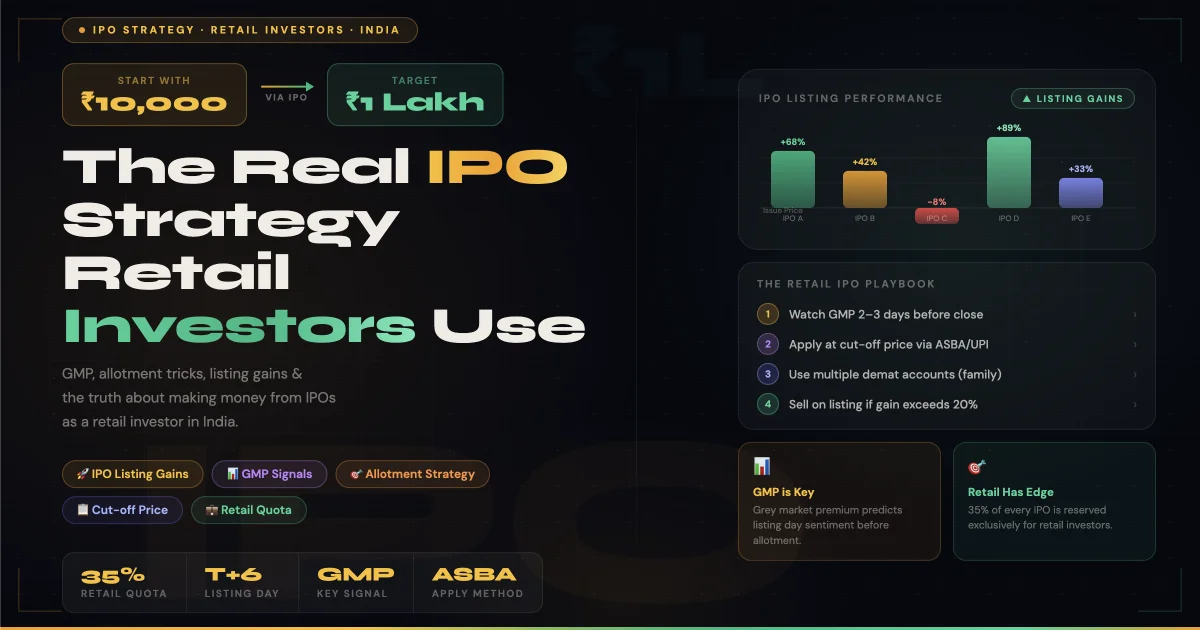
Retail investor category: The Indian IPO system reserves 35% of shares for Retail Individual Investors (RII) — individuals applying for shares worth up to ₹2 lakh total. This reservation is specifically designed to give ordinary investors access to IPOs before institutional players consume everything.
Minimum application (1 lot): Each IPO defines a minimum lot size — typically 10–50 shares per lot. At ₹400/share with 35 shares per lot, the minimum application is ₹14,000. Most retail investors apply for exactly 1 lot — the minimum — to maximise their allotment probability (explained in allotment section below).
Subscription and oversubscription: When more applications arrive than shares available, the IPO is "oversubscribed." A 50x oversubscribed IPO means 50 times more applications than available retail shares — which means your probability of allotment is approximately 1 in 50, or about 2%.
GMP of IPO — What It Is, Why Everyone Watches It, and How to Read It
What Is GMP in IPO?
GMP stands for Grey Market Premium. It is the unofficial, unregulated premium at which IPO shares trade in the "grey market" — an informal market that exists before the IPO officially lists on the stock exchange.
The grey market is not regulated by SEBI. It is not legal in the formal sense — no exchange oversees it. It is, however, widely tracked by Indian retail investors as an informal indicator of expected listing price.
How GMP works — a simple example:
- IPO issue price: ₹420
- Current GMP: ₹180
- Expected listing price: ₹420 + ₹180 = ₹600
- Expected listing gain: ₹180 ÷ ₹420 = approximately 43%
If you applied for 1 lot of 35 shares at ₹420, you paid ₹14,700. At a ₹600 listing price, your 35 shares would be worth ₹21,000 — a gain of ₹6,300 in one week if you sell on listing day.
Live IPO GMP — Where to Track It
The most popular platforms for tracking live IPO GMP and upcoming IPO GMP in India:
- IPO Watch (ipowatch.in) — one of the most referenced sources for ipo watch gmp data. Shows GMP, subscription status, and listing estimates.
- Chittorgarh (chittorgarh.com) — widely used for SME IPO tracking, allotment status checks, and GMP history
- InvestorGain (investorgain.com) — shows GMP trends over time, not just current GMP
⚠️ Critical warning about GMP:
GMP is not a reliable predictor of actual listing price. Here is the data that most GMP-focused YouTube videos and WhatsApp forwards conveniently omit:
- High GMP IPOs frequently list below GMP expectations — especially in oversubscribed markets
- GMP can be artificially inflated by operators who have accumulated grey market positions and want retail investors to apply more, driving up subscription numbers
- GMP measured 1–2 days before listing is more reliable than GMP measured 7–10 days before listing
- Multiple high-profile IPOs in 2023–2025 had GMP of ₹200–₹300 and listed at issue price or below
The correct way to use GMP: Treat it as one data point among many — not as a listing price guarantee. High GMP with strong fundamentals and reasonable valuation = more confidence. High GMP with weak fundamentals and stretched valuation = proceed with caution regardless of GMP.
IPO Allotment Status NSE — How Allotment Works and How to Check Yours
How IPO Allotment Works in India
When an IPO is oversubscribed in the retail category, SEBI's allotment rules determine who gets shares:
Rule 1 — One lot per applicant first: In heavily oversubscribed IPOs, SEBI mandates that the registrar must first try to give at least 1 lot to every applicant before giving 2 lots to anyone. This is why applying for exactly 1 lot is often the optimal strategy for retail investors — you get the same probability as someone applying for 14 lots (the maximum for retail category at ₹2 lakh limit) but without blocking 14x more capital.
Rule 2 — Lottery when oversubscribed: If there are more 1-lot applicants than available lots, a computerised lottery determines who gets allotment. Every application has exactly equal probability — a demat account with 1 application has the same chance as any other 1-lot application.
Rule 3 — Multiple demat accounts = multiple lottery tickets: This is the legal strategy most serious IPO investors use — applying from multiple family members' demat accounts. Each account is a separate lottery entry. Applying from your own account + spouse's account + parent's account = 3x the allotment probability compared to a single application.
IPO Allotment Tips and Strategies — What Actually Improves Your Chances
These are the legitimate, legal strategies that experienced Indian retail IPO investors use. This is educational information about how the system works — not a recommendation to follow any strategy:
1. Apply at the cut-off price: Always select "Cut-off Price" when applying via UPI or ASBA. This ensures your application is valid regardless of where the final issue price falls within the band. Applications at specific prices below cut-off can be rejected if the price is set higher.
2. Apply early in the subscription window: Technical glitches and server crashes are common on the last day of IPO subscriptions — especially for high-demand IPOs. Applying on Day 1 or Day 2 avoids last-minute technical failures that could invalidate your application.
3. Apply from maximum eligible family member accounts: Each family member with a PAN card and demat account is a separate eligible applicant. Husband + wife + mother + father = 4 separate legitimate applications. All must be from different PAN numbers and demat accounts.
4. Use multiple broker platforms: You can apply from the same demat account through only one platform. But if different family members have demat accounts at different brokers (Zerodha, Groww, Upstox, HDFC Securities), each applies through their own broker.
5. Check UPI mandate before closing time: IPO applications via UPI require you to approve the mandate in your UPI app (PhonePe, Google Pay, BHIM) within the specified time. Unapproved mandates result in application rejection — a very common reason for failed applications.
6. Avoid applying on the last day: Subscription servers of most brokers experience 10x normal traffic on IPO closing day. Apply on Day 1 — same allotment probability, significantly fewer technical issues.
How to Check IPO Allotment Status on NSE
After the subscription closes and allotment is finalised (typically T+6 days from IPO close), check your status here:
Method 1 — NSE official:
- Go to nseindia.com
- Navigate to: Market → IPO → IPO Allotment Status
- Select the IPO name from dropdown
- Enter your PAN number or Application Number
- Click Submit — allotment status shows immediately
Method 2 — BSE official:
- Go to bseindia.com/investors/ appli_check.aspx
- Select Issue Type: Equity
- Select Issue Name from dropdown
- Enter Application Number or PAN
- Enter the captcha → Submit
Method 3 — Registrar website: Each IPO has a registrar (KFintech, Link Intime, Bigshare Services). Check the IPO prospectus for the registrar name — their website also shows allotment status via PAN number lookup.
What Is SME IPO — The High-Risk, High-Reward Segment Most Retail Investors Don't Understand
SME IPO Means — Definition
An SME IPO (Small and Medium Enterprise IPO) is an IPO by a small or medium-sized company that lists on the BSE SME platform or NSE Emerge platform rather than the main BSE/NSE exchanges.
Key differences between Mainboard IPO and SME IPO:
- Company size: Mainboard companies typically have post-issue paid-up capital above ₹10 crore. SME companies have paid-up capital between ₹1 crore and ₹25 crore.
- SEBI scrutiny: Mainboard IPOs undergo more extensive SEBI review. SME IPOs have a lighter regulatory framework — which means faster listing but also higher risk.
- Minimum lot size: SME IPOs typically have much larger minimum lot sizes — ₹1 lakh to ₹2 lakh per lot — meaning minimum investment is significantly higher than mainboard IPOs.
- Liquidity: SME stocks have significantly lower trading volume after listing. This means exits can be difficult — you may hold a stock you want to sell but find no buyers at your desired price.
- GMP volatility: SME IPO GMPs are notoriously volatile and unreliable. Small market capitalisation means a handful of large buyers can move the grey market price dramatically.
BSE SME IPO Index
The BSE SME IPO Index tracks the performance of companies that have listed via the SME platform. As a benchmark, it tells you how the SME segment as a whole is performing — not individual stocks.
Historically, the BSE SME IPO Index has shown spectacular gains during bull markets — and equally spectacular declines during corrections. The index is not representative of what an individual retail investor experiences — because individual SME stocks show far wider variance than any index.
⚠️ Important note on SME IPOs: SEBI has in recent years tightened scrutiny on SME IPOs following concerns about price manipulation, operator activity, and promoters using the SME platform to create artificial valuations. Several SEBI enforcement orders in 2023–2025 specifically targeted SME IPO manipulation. Retail investors should treat SME IPOs with significantly more caution than mainboard IPOs.
IPO Listing Gain — The Real Math Behind the Headlines
Here is the honest, complete picture of IPO listing gains for Indian retail investors — information that is rarely presented together in one place:
The positive case (real examples):
- Tata Technologies IPO (Nov 2023): Issue price ₹500, listed at ₹1,200 — 140% listing gain
- Jyoti CNC Automation IPO (Jan 2024): Issue price ₹331, listed at ₹ 731 — 121% listing gain
- Vibhor Steel Tubes (Feb 2024): Massive listing gain for allottees
The complete picture (same period):
- Many IPOs in 2023–2025 listed at 0–15% gain — meaningful but not the 2x–3x stories that circulate
- Several IPOs listed below issue price — allottees who held were immediately sitting on a loss
- For a heavily oversubscribed IPO with 80x retail subscription, your allotment probability is approximately 1 in 80 (1.25%). Applying from 4 family member accounts raises this to approximately 4 in 80 (5%) — still not guaranteed.
The realistic expected value calculation for retail IPO investing:
Assume you apply for every IPO in a year (approximately 60–80 mainboard and SME IPOs combined in 2024–2025) from one account:
- Applications per year: 70
- Average allotment rate for retail at 1 lot: approximately 30–40% (many IPOs are not heavily oversubscribed)
- Allotments expected: approximately 25
- Average listing gain on allotted IPOs (across winners and flat/negative ones): approximately 15–25%
- Average lot size: approximately ₹14,000
- Expected gross profit per allotment: approximately ₹2,100–₹3,500
- Total expected gross profit from 25 allotments: approximately ₹52,500–₹87,500
This is not ₹10,000 to ₹1 lakh. But it is a meaningful supplementary return strategy for investors who apply systematically, from multiple accounts, across a full year.
The capital tied up during application period: Under UPI ASBA, your money is blocked in your bank account but not debited until allotment. If you are simultaneously applying from 4 family accounts at ₹14,000 each, ₹56,000 is blocked for 6–7 days per IPO application cycle. For active IPO applicants applying to multiple IPOs simultaneously, this capital blocking is a real operational consideration.
IPO Review — How to Evaluate an IPO Before Applying
Rather than relying solely on GMP, here is the framework that informed retail investors use to evaluate whether an IPO is worth applying to:
1. Valuation — Is the issue price fair?
Compare the IPO's P/E ratio
to its listed peers.
If the company is being offered
at 80x earnings when its
sector peers trade at 30x,
the IPO is aggressively priced.
High GMP at stretched valuations
has historically been a reliable
warning sign of post-listing decline
after initial euphoria fades.
2. Business quality — Does it make money?
Check the Red Herring Prospectus (RHP) —
available on SEBI's EDIFAR system
and the registrar's website.
Key metrics to check:
revenue growth (last 3 years),
profit after tax trend,
debt-to-equity ratio,
and return on equity (ROE).
A company with declining profits
or negative ROE raising money
via IPO deserves extra scrutiny.
3. Use of proceeds — Where is the money going?
An IPO where the primary use of funds
is "offer for sale" (OFS — existing
shareholders selling their stake)
means the company is not raising
fresh capital for growth.
The promoters and early investors
are simply cashing out.
This is not necessarily bad —
but it means the company gets
no new money from the IPO.
4. Promoter background and reputation:
Check if the promoters have
previous listed companies —
and how those companies performed.
SEBI's order database
(sebi.gov.in/enforcement/orders)
shows if any promoter has
prior SEBI action against them.
5. IPO review sources worth reading:
Chittorgarh, IPO Watch,
and Investorgain all publish
pre-IPO reviews covering
the above metrics in digestible format.
Read the review, check the GMP,
then make your own assessment.
Never apply based on GMP alone.
₹10,000 to ₹1 Lakh — The Honest Reality Check
The headline "₹10,000 to ₹1 lakh via IPO" implies a 10x return from a single investment. Let's be honest about when and how this has actually happened — and how often:
Scenario where this is theoretically possible:
You apply for an SME IPO with
minimum lot size of ₹1 lakh
(not ₹10,000 — the lot size itself
is already ₹1 lakh or more in many SME IPOs).
The stock lists at 3x.
Your ₹1 lakh becomes ₹3 lakh —
a ₹2 lakh gain. This has happened.
It is documented. It is also rare,
not replicable on demand,
and the same SME segment has produced
stocks that listed at 50% below
issue price and never recovered.
The more realistic IPO journey:
Systematic application across
multiple IPOs from multiple family accounts,
focusing on fundamentally sound companies
at reasonable valuations,
using GMP as one signal among many,
and booking profits on listing day
rather than holding for long-term gains
(most IPOs that give listing gains
are not necessarily great
long-term compounders).
What IPO investing is not:
- Not a reliable path to 10x returns
- Not a substitute for systematic SIP investing in index funds
- Not a strategy that works consistently from a single account
- Not something where GMP alone predicts outcome reliably
What IPO investing can be:
- A supplementary strategy that generates meaningful additional returns for investors who apply systematically
- A way to participate in quality companies at the IPO stage at prices unavailable to retail investors after listing
- An educational tool — reading IPO prospectuses builds genuine understanding of how businesses raise capital and are valued
Track Your IPO Applications and Returns Honestly
Here is a behaviour pattern common among retail IPO investors: they remember the allotments that gave 40–80% listing gains and forget the capital blocked across 30 applications that yielded zero allotment.
When you don't track the complete picture, you overestimate your IPO strategy's actual returns. The capital blocked during application periods has an opportunity cost — that money could have been earning returns in a liquid fund or index fund during the 6–7 day blocking period.
Honest tracking reveals the truth: for most retail investors, systematic IPO application generates supplementary returns of ₹30,000–₹80,000 per year (across all allotments) — meaningful, but not life-changing, and not comparable to the headline stories that circulate.
Use RozHisab to log every IPO application — amount applied, allotment received (yes/no), listing gain or loss, and net profit per IPO. See your actual annual IPO return vs capital deployed in one dashboard. When you can see the real numbers, you make better decisions about which IPOs are worth applying to and whether the strategy is working for your specific situation.
Because the difference between an investor who profits from IPOs and one who just thinks they do — is honest tracking of every application, every allotment, and every exit.
👉 Track your IPO portfolio and all investments for free at RozHisab — built for Indian retail investors who want clarity over noise.
Quick Reference — IPO Investing for Indian Retail Investors
- 📊 GMP of IPO: Grey Market Premium — unofficial expected listing premium. Useful indicator, not a guarantee. Check on ipowatch.in or chittorgarh.com
- 🎯 Best allotment strategy: Apply for exactly 1 lot from maximum eligible family accounts. Apply on Day 1. Always select cut-off price. Approve UPI mandate immediately.
- ✅ Check allotment status: nseindia.com or bseindia.com using your PAN number — available T+6 from IPO close
- 🏢 SME IPO means: Small company IPO on BSE SME or NSE Emerge platform. Higher minimum lot, higher risk, lower liquidity. Higher SEBI caution advised.
- 📋 Before applying — check: P/E vs peers, revenue growth trend, use of IPO proceeds, promoter background, and GMP trend (not just current GMP)
- 💰 Realistic
Track your own finances — free forever
Use RozHisab to apply everything in this article to your actual spending and savings.
Start Tracking Free →