ℹ️ Disclaimer: This article is for general educational and informational purposes only. Salary structures, tax calculations, PF rates, HRA exemptions, and professional tax slabs vary by employer, state, and individual circumstances. All examples and figures used here are illustrative only. Tax laws change periodically. Please consult your HR department, payroll team, or a qualified tax professional for advice specific to your salary structure. RozHisab is a personal finance tracking tool — not a tax or legal advisory service.
You receive your salary slip every month. You check one number — the amount credited to your bank account — and move on.
That one number is the least informative thing on the entire document.
The salary slip contains the complete picture of your financial relationship with your employer — how much you actually cost the company, how much the government takes, how much goes into your retirement fund, what you can claim as tax exemption, and how much you actually take home.
Most salaried Indians understand less than half of these components. That gap costs them money every year — in unclaimed HRA exemptions, misunderstood PF deductions, and tax filed incorrectly because the salary slip was never properly read.
This guide explains every single component of an Indian salary slip — with real numbers, real formulas, and plain language.
The Three Salary Numbers Every Indian Employee Hears — CTC, Gross, and Net
Before getting into individual components, understand the three headline salary figures that are constantly confused with each other:
CTC Full Form — What It Means
CTC full form: Cost to Company.
CTC full form in salary context: CTC is the total annual expense your employer incurs to employ you — including everything they pay directly to you, everything they pay on your behalf to the government, and everything they contribute to your retirement and benefits.
CTC includes:
- Your gross salary (all components paid to you)
- Employer's contribution to PF (12% of basic — you never see this in your bank account but it is part of CTC)
- Employer's contribution to ESI (if applicable — for salaries below ₹21,000/month)
- Gratuity provision (4.81% of basic salary set aside annually)
- Any other benefits — group health insurance premium paid by employer, company car, meal vouchers, telephone allowance
CTC is always higher than what you actually receive. The gap between your CTC and your in-hand salary can be ₹3,000 to ₹20,000+ per month depending on your CTC level.
CTC calculator — the basic formula:
CTC = Gross Salary +
Employer's PF Contribution +
Gratuity + Other Benefits
Example with a ₹6 lakh annual CTC:
- Gross salary: ₹5,40,000/year (₹45,000/month)
- Employer PF (12% of basic ₹22,500): ₹2,700/month = ₹32,400/year
- Gratuity (4.81% of basic): ₹1,082/month = ₹12,984/year
- Group health insurance: ₹14,616/year
- Total CTC: ₹6,00,000/year ✓
⚠️ The most common salary negotiation mistake: When a job offer says "CTC ₹6 LPA," your monthly in-hand salary will be significantly lower than ₹50,000/month — typically ₹38,000–₹42,000 depending on your tax bracket and salary structure. Always ask for the in-hand breakup, not just the CTC number.
Gross Pay — What It Is
Gross pay is your total monthly salary before any deductions — the sum of all allowances and components paid to you by your employer. It does not include employer contributions (which are separate from your gross pay but part of CTC).
Gross pay = Basic + HRA + DA + Special Allowance + All Other Allowances
Net Pay — Your Actual Take-Home
Net pay (also called net salary or in-hand salary) is what gets credited to your bank account — gross pay minus all deductions.
Net pay = Gross Pay − (Employee PF + Professional Tax + TDS Income Tax + ESI if applicable)
Gross Pay vs Net Pay — The Exact Difference
Gross pay vs net pay difference: Gross pay is your salary before any cuts. Net pay is your salary after all statutory and tax deductions. The difference between the two is the total of all your monthly deductions.
Simple formula:
Net Pay = Gross Pay − Total Deductions
For most salaried Indians, net pay is 75–90% of gross pay — the remaining 10–25% goes toward PF, professional tax, and income tax (TDS).
The Salary Slip Format — Every Component Explained
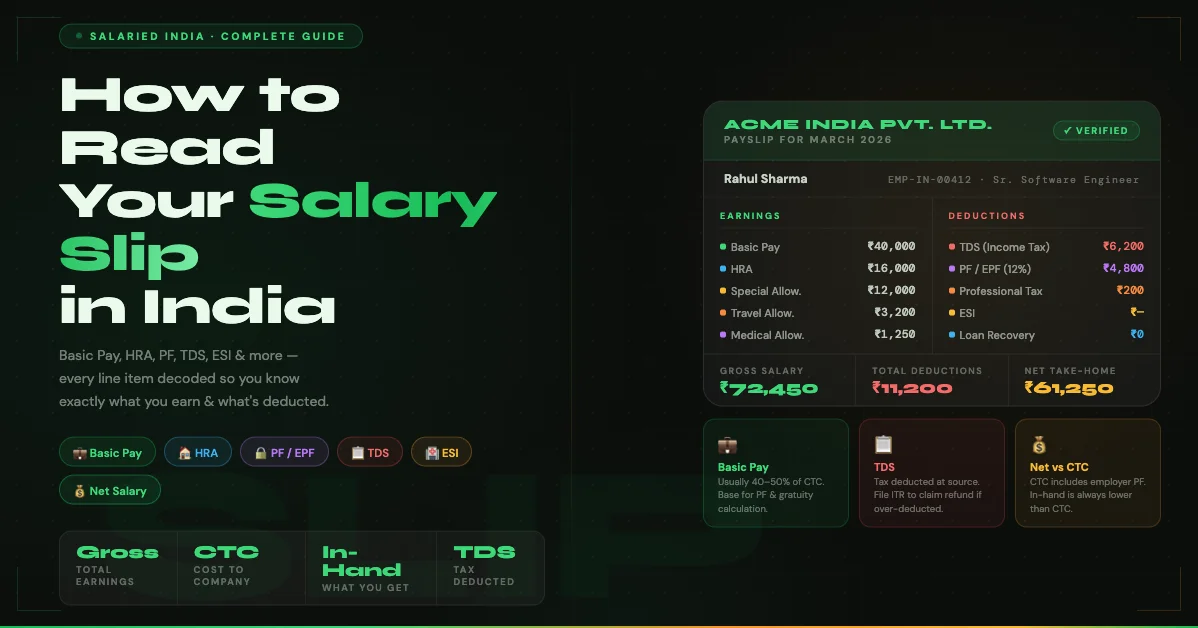
A standard Indian salary slip (payslip format) has two main sections: Earnings (what you're paid) and Deductions (what is taken out). Here is every component in both sections:
EARNINGS SIDE — Every Component
1. Basic Salary
What it is: The fixed core component of your salary — the foundation on which all other components are calculated. It is fully taxable with no exemption.
Basic salary percentage: Typically 40–50% of gross salary in most private sector companies. Government employees have different basic salary structures under Pay Commissions (the 7th Pay Commission currently and the 8th Pay Commission recommendations pending).
Why basic salary matters beyond the payslip:
- PF is calculated on basic: Your PF deduction = 12% of basic salary. Higher basic = higher PF deduction = lower in-hand but higher retirement savings.
- HRA is calculated on basic: HRA exemption formula uses basic salary as the reference point.
- Gratuity is calculated on basic: Gratuity = (Basic Salary × 15 × Years of Service) ÷ 26
- Leave encashment uses basic: When you encash unused leave, the payout is based on basic salary per day.
How to calculate basic salary:
If your gross is ₹50,000/month
and basic is 40% of gross:
Basic = 40% × ₹50,000 = ₹20,000/month
8th Pay Commission basic salary: For central government employees, the 8th Pay Commission (recommendations expected by 2026) will revise basic pay scales. The fitment factor (multiplier applied to current basic) determines the new basic salary. Once implemented, this will directly impact PF, gratuity, and HRA calculations for government employees.
2. HRA — House Rent Allowance
What it is: An allowance paid by your employer to cover your rental housing expenses. It is one of the most valuable tax-saving components on your salary slip — partially or fully exempt from income tax if you live in rented accommodation.
HRA received vs HRA exemption — the critical distinction: Your salary slip shows the HRA your employer pays you. The HRA exemption is the portion of that HRA which is tax-free. These are not the same number.
HRA exemption section — Section 10(13A) of Income Tax Act.
How to calculate HRA exemption: The tax-exempt HRA is the minimum of these three amounts:
- Actual HRA received from employer
- Actual rent paid − 10% of basic salary
- 50% of basic salary (metro cities — Delhi, Mumbai, Chennai, Kolkata) OR 40% of basic salary (non-metro cities)
HRA exemption example (illustrative):
Basic salary: ₹20,000/month
HRA received: ₹10,000/month
Actual rent paid: ₹12,000/month
City: Bangalore (metro)
- Actual HRA received: ₹10,000
- Rent − 10% of basic: ₹12,000 − ₹2,000 = ₹10,000
- 50% of basic (metro): ₹10,000
- HRA exemption = ₹10,000/month (minimum of all three)
In this case, the entire HRA received is tax-exempt because all three calculations give the same result.
To claim HRA exemption:
- Submit rent receipts to your employer (for rent above ₹8,333/month, landlord's PAN is mandatory)
- Keep rent agreement as supporting document
- If employer doesn't process it, claim directly in ITR under Section 10(13A) when filing returns
⚠️ You CANNOT claim HRA exemption if you own the house you live in — even if you pay a nominal rent to a family member. The exemption is only for genuine rental payments.
3. DA — Dearness Allowance
What is dearness allowance: DA is a cost-of-living adjustment paid to government employees and some PSU employees to compensate for inflation. It is calculated as a percentage of basic salary and revised twice a year (January and July) by the central government for central government employees.
Central government dearness allowance 2026: DA for central government employees is revised based on the Consumer Price Index (CPI). As of early 2026, central government DA is approximately 53–55% of basic salary (check dearness allowance latest news on the Ministry of Finance website for the exact current rate as it changes twice yearly).
DA for private sector employees: Most private companies do not pay a separate DA component. Instead, inflation adjustments are built into annual salary hikes or absorbed into the Special Allowance component. If your private sector salary slip shows DA, it is typically a legacy component from older salary structures.
Is DA taxable? Yes — DA is fully taxable as part of your salary income. There is no exemption for DA unlike HRA.
4. Special Allowance
What it is: The balancing component that fills the gap between (Basic + HRA + DA) and the total gross salary. It is essentially the "everything else" bucket in your salary structure.
Is special allowance taxable? Yes — fully taxable. No exemption available on special allowance.
Why employers create special allowance: Companies use it to give flexibility in salary structuring without committing to a higher basic salary (which would increase their PF and gratuity liability). A higher special allowance with lower basic = lower employer PF contribution = lower cost to company.
5. Conveyance Allowance / Transport Allowance
What it is: An allowance to cover your daily commuting costs. For most private sector employees, this is now merged into Special Allowance following the removal of specific transport allowance exemption in the 2018 Budget (replaced by the flat ₹50,000 standard deduction for salaried individuals).
For government employees, a separate transport allowance continues to apply with specific rates based on city and pay level.
6. Medical Allowance
What it is: An allowance for medical expenses. The old ₹15,000 annual medical exemption was removed in Budget 2018 and replaced by the standard deduction. Medical allowance is now fully taxable for most employees. Some employers still pay it as a separate component but it no longer carries a specific tax benefit.
7. LTA — Leave Travel Allowance
What it is: An allowance provided for travel expenses incurred during leave. LTA is tax-exempt under Section 10(5) for actual travel costs within India — subject to conditions:
- Exemption covers travel fare only (not hotel or food)
- Travel must be within India
- Exemption can be claimed for 2 journeys in a block of 4 calendar years (current block: 2022–2025)
- Furthest point by shortest route is the basis for exemption calculation
LTA received but not claimed for eligible travel is fully taxable.
DEDUCTIONS SIDE — Every Component
1. Employee PF (Provident Fund) Deduction
What it is: Your monthly contribution to the Employees' Provident Fund (EPF) — a government-mandated retirement savings scheme managed by EPFO (Employees' Provident Fund Organisation).
Is PF deduction mandatory? Yes — for all employees earning basic salary up to ₹15,000/month, PF deduction is mandatory if the employer has 20 or more employees. For employees earning above ₹15,000 basic, technically PF contribution is optional — but most employers deduct it for all employees regardless as a standard practice.
Maximum PF deduction: Employee contribution = 12% of basic salary. There is no statutory maximum — but the employer's matching contribution is capped at 12% of ₹15,000 = ₹1,800/month. If your basic exceeds ₹15,000, the employer is only legally required to contribute ₹1,800/month — though many employers contribute 12% of actual basic.
PF deduction in new tax regime: The employee's own PF contribution qualifies for Section 80C deduction (up to ₹1.5 lakh combined) under the old tax regime only. Under the new tax regime, Section 80C deductions including PF are not available. However, the PF account itself (EPF) still earns tax-free interest and the maturity amount remains tax-free regardless of which regime you choose.
Employer contribution to PF deduction under 80C: The employer's PF contribution is NOT eligible for 80C deduction by the employee — only your own (employee's) contribution qualifies. The employer's contribution is also part of your CTC but does not appear on the deductions side of your payslip.
Where does your PF money go?
- Employee's 12% → 100% to EPF account
- Employer's 12% → 8.33% to EPS (Employees' Pension Scheme, capped at ₹1,250/month) + 3.67% to EPF
Check your EPF balance anytime at passbook.epfindia.gov.in using your UAN (Universal Account Number).
2. Professional Tax
What it is: A state-level tax on employment income. Not all states levy professional tax — it is applicable in Maharashtra, Karnataka, West Bengal, Tamil Nadu, Andhra Pradesh, Telangana, Gujarat, and a few others. Delhi, Haryana, Rajasthan, and several other states do not levy professional tax.
Professional tax slab — state-wise (illustrative, verify current rates):
Maharashtra professional tax slab:
- Monthly salary up to ₹7,500: Nil
- ₹7,501 – ₹10,000: ₹175/month
- Above ₹10,000: ₹200/month (₹300 in February — making annual total ₹2,500)
Karnataka professional tax slab:
- Monthly salary up to ₹15,000: Nil
- ₹15,001 – ₹29,999: ₹150/month
- Above ₹30,000: ₹200/month
West Bengal professional tax slab:
- Up to ₹10,000: Nil
- ₹10,001 – ₹15,000: ₹110/month
- ₹15,001 – ₹25,000: ₹130/month
- ₹25,001 – ₹40,000: ₹150/month
- Above ₹40,000: ₹200/month
Maximum professional tax in India: ₹2,500 per year — capped by Article 276 of the Constitution.
Is professional tax deductible? Yes — professional tax paid is allowed as a deduction from gross salary under Section 16(iii) of the Income Tax Act. Your employer deducts it and deposits it with the state government — and the amount appears on Form 16.
3. TDS — Tax Deducted at Source
What it is: Income tax deducted by your employer from your monthly salary on behalf of the Income Tax Department. Your employer estimates your annual tax liability, divides it by 12, and deducts this amount every month.
How TDS is calculated on salary:
- Estimate annual gross salary
- Subtract exemptions (HRA, LTA, standard deduction of ₹50,000)
- Subtract declared investments under Chapter VI-A (80C, 80D, etc.) under old regime — OR use new regime slabs directly
- Calculate tax on taxable income
- Divide by 12 = monthly TDS
New vs Old regime TDS: From FY 2023-24, the New Tax Regime is the default. If you want TDS calculated under the Old Regime (to claim HRA, 80C, 80D deductions), you must explicitly opt for Old Regime by submitting a declaration to your employer at the start of each financial year.
TDS on salary — key slabs (New Tax Regime, FY 2025-26):
- Up to ₹3 lakh: Nil
- ₹3 lakh – ₹7 lakh: 5%
- ₹7 lakh – ₹10 lakh: 10%
- ₹10 lakh – ₹12 lakh: 15%
- ₹12 lakh – ₹15 lakh: 20%
- Above ₹15 lakh: 30%
TDS deducted by employer is reflected in Form 26AS — always verify that your employer has actually deposited the deducted TDS before filing your ITR.
4. ESI — Employee State Insurance
What it is: A social security and health insurance scheme for employees earning gross salary up to ₹21,000/month. If your gross salary exceeds ₹21,000, you are not covered by ESI.
ESI deduction rates:
- Employee contribution: 0.75% of gross salary
- Employer contribution: 3.25% of gross salary
ESI provides medical benefits, maternity benefits, disability benefits, and dependent benefits to covered employees. If ESI appears on your salary slip, you and your dependents can access ESI hospitals and dispensaries.
Monthly Salary Slip Format — A Complete Real-World Example
Here is a complete illustrative salary slip for an employee with ₹8 lakh annual CTC in Bangalore (metro city, rented accommodation, old tax regime):
EARNINGS:
- Basic Salary: ₹26,700
- HRA (50% of basic, metro): ₹13,350
- Special Allowance: ₹17,950
- Transport Allowance: ₹1,600
- Gross Salary: ₹59,600
DEDUCTIONS:
- Employee PF (12% of basic): ₹3,204
- Professional Tax (Karnataka): ₹200
- TDS (based on annual projection): ₹2,800
- Total Deductions: ₹6,204
NET PAY (In-Hand): ₹53,396/month
CTC Reconciliation:
- Annual Gross (₹59,600 × 12): ₹7,15,200
- Employer PF (12% of basic × 12): ₹38,376
- Gratuity (4.81% of basic × 12): ₹15,424
- Group Health Insurance: ₹31,000
- Total Annual CTC: ₹8,00,000 ✓
Notice: CTC ₹8 lakh but in-hand is only ₹53,396/month (₹6.4 lakh annually) — a gap of ₹1.6 lakh per year between CTC and actual take-home. This is why CTC is a misleading number without the full breakup.
Payslip Format in Excel and Word — What to Look for in Your Company's Format
Indian companies use a wide variety of payslip formats — some elaborate with 15+ line items, some simple with 5–6 lines. Regardless of format, every legitimate Indian payslip must show:
- ✅ Employee name, employee ID, designation
- ✅ PAN number (or last 4 digits)
- ✅ UAN (Universal Account Number for PF)
- ✅ Pay period (month and year)
- ✅ Number of days worked and LOP (Loss of Pay) days if any
- ✅ All earnings components with amounts
- ✅ All deduction components with amounts
- ✅ Gross pay, total deductions, net pay
- ✅ Employer's name and address
If your salary slip is missing UAN, PAN, or the breakdown of PF deduction — raise this with your HR. These are required for EPF claims, home loan processing, and ITR filing.
Three Common Salary Slip Mistakes That Cost Indian Employees Money
Mistake 1 — Not submitting
rent receipts for HRA exemption:
Thousands of salaried Indians
in rented accommodation fail to
submit rent receipts to HR by
the February deadline every year.
The result: employer deducts full
TDS without HRA exemption,
and the employee must claim
the refund in ITR — which delays
the benefit by 6–12 months.
Submit rent receipts in January–February
every year without exception.
Mistake 2 — Not checking
Form 26AS before filing ITR:
Form 26AS shows how much TDS
your employer has actually deposited
with the tax department.
If your salary slip shows ₹2,800
TDS deducted but Form 26AS shows
only ₹1,400 deposited
(employer error or non-payment),
you cannot claim credit for ₹2,800
in your ITR. Always verify Form 26AS
matches your salary slip TDS totals
before filing returns.
Mistake 3 — Not opting for
the correct tax regime with HR:
The new tax regime is the default.
If you have significant HRA, 80C,
80D, and home loan deductions,
the old regime often results in
lower total tax.
But your employer calculates TDS
based on whichever regime is
on record. If you don't declare
the old regime preference to HR
at the start of the financial year,
you'll overpay TDS all year and
wait for a refund after filing.
Calculate both regimes in April —
then tell HR which one to use.
Track Your In-Hand Salary Against Your Monthly Expenses
Most salaried Indians know their gross salary and their CTC. Very few know their actual monthly savings rate — what percentage of their net in-hand salary is actually being saved versus spent.
The salary slip gives you the income side of your financial picture. What most people are missing is the expense side — where the in-hand salary actually goes after it hits the bank account.
Use RozHisab to log your monthly net salary alongside every expense — rent, groceries, transport, EMIs, subscriptions, dining, and savings. See your actual monthly savings rate, your biggest spending categories, and whether your in-hand salary is being allocated the way you intended — all in one free dashboard built for Indian salaried households.
Because understanding your salary slip is step one. Knowing what you actually do with that salary every month is step two — and it's the step that determines whether you build wealth or just earn it.
👉 Start tracking your salary and expenses for free at RozHisab — built for Indian salaried employees who want to know exactly where every rupee of their in-hand salary goes each month.
Quick Reference — Every Salary Slip Component at a Glance
- 💼 CTC full form: Cost to Company — total employer cost including PF, gratuity, and benefits. Always higher than in-hand.
- 📊 Basic salary percentage: 40–50% of gross in most private companies. PF, HRA, and gratuity are all calculated on basic.
- 🏠 HRA exemption section: Section 10(13A) — exempt up to minimum of: actual HRA, rent−10% basic, or 50%/40% basic. Submit rent receipts by February.
- 📈 What is dearness allowance: Cost-of-living adjustment for government employees — revised twice yearly, fully taxable.
- 💰 Is PF deduction mandatory: Yes — 12% of basic salary, for employees with basic ≤ ₹15,000. Optional above ₹15,000 but most employers deduct regardless.
- 🏛️ Professional tax slab: State-level tax, max ₹2,500/year. Not applicable in Delhi, Haryana, Rajasthan, and several other states.
- 📋 Gross pay vs net pay: Gross = all earnings before deductions. Net = gross minus PF + PT + TDS. Difference = your total monthly deductions.
- 📱 Track in-hand salary: Log on RozHisab monthly — see savings rate and spending breakdown automatically.
📌 Disclaimer: This article is for educational and informational purposes only. Salary structures, tax slabs, PF rates, HRA exemption calculations, professional tax slabs, and dearness allowance rates vary by employer, state, and financial year and change periodically. All figures and examples are illustrative only. Please consult your HR department or a qualified tax professional for advice specific to your situation. RozHisab is a budgeting and expense tracking tool — not a tax or legal advisory service.
Track your own finances — free forever
Use RozHisab to apply everything in this article to your actual spending and savings.
Start Tracking Free →